About 40 minutes
Bulldog — Inside the Classic
Adventure Picaresque Fiction
9,146 recorded words. 0 minutes difference from this book's estimate.
View Gutenberg source #68868
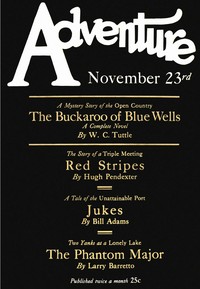
The catalog record for Red stripes — Reading Notes provides practical reading context through 9,121 words, 40 min estimated reading time, and 1 detected text section.
The text analysis averages about 14.8 words per sentence, while the detected sections provide another way to judge how the source is divided.
Project Gutenberg metadata also associates the work with “Short stories,” connecting these edition facts with the source record’s subject description.
Explore this collection
These alternatives are selected using recorded categories and estimated reading time.
About 40 minutes
Adventure Picaresque Fiction
9,146 recorded words. 0 minutes difference from this book's estimate.
View Gutenberg source #68868About 140 minutes
Adventure Picaresque Fiction
32,160 recorded words. 100 minutes difference from this book's estimate.
View Gutenberg source #66996About 174 minutes
Adventure Picaresque Fiction
39,921 recorded words. 134 minutes difference from this book's estimate.
View Gutenberg source #67169Search stored excerpts and compare books → Choose by your preferences →
Choices use stored catalog measurements. Estimates vary with reading speed. A shared category is a catalog label, not a claim that two books have the same argument or literary quality.
Search reads excerpt text stored with this catalog and links to its associated Gutenberg record. The connection is stored in the site database; this tool does not recheck that every excerpt is word-for-word identical to that external record. Excerpt search does not cover every chapter and does not verify historical publication dates.
Catalog snapshot checked: 2026-09-25. Coverage: 92 public books, 92 available source excerpts.
Calculated from edition completeness, EPUB availability, text structure and catalogue metadata. Not a user rating.
Total of 100 points, scaled to a 2.5-5.0 range. Editions with an empty description or a missing EPUB file are not scored.
Public-domain source text
The source text is kept in the dedicated reader, separate from this catalogue record and its commentary.
The story opens with a Virginian captive being led by Wyandots down the Big Sandy and up the Ohio, his body bound and bruised. The leader wears no face paint but a single red stripe down his spine—a mark that becomes a recurring test of allegiance. Pendexter builds tension through physical detail: the rawhide thong around the prisoner's waist, the cord around his neck, the briers scratching from head to waist. The narrative moves swiftly between the captive's internal resentment and the external dangers of the border, where a man's back can betray him.
The red stripe is not merely a decoration; it is a badge of belonging. The Wyandot leader and his men all wear it, while the captive does not. Later, when the escaped Virginian meets strangers in the woods, the first question is whether a man bears that stripe. Kinsty, a seasoned frontiersman, insists on lifting a man's hunting-shirt to check his back before trusting him. The stripe becomes a shorthand for loyalty—or its absence. Pendexter uses this physical mark to externalize the internal question of who is friend and who is foe. The reader, like the characters, learns to scan backs for that telltale line.
The story is structured around a series of crossings: from the station on the Big Sandy to the Indian shore, then back across the Ohio to the Kentucky side. Each crossing raises the stakes. The captive is dragged through water, forest, and camp, always in motion. Even after escape, the characters debate whether to push on to Massie's Station or stay put. Pendexter uses the river as a boundary between safety and danger, but also as a space where identities are tested. The constant movement—by canoe, on foot, through brush—mirrors the unsettled nature of frontier life, where no place is secure for long.
Pendexter distinguishes his characters through speech patterns. Abner Bryant speaks in a monotonous voice, recounting his capture with flat resignation: “We was took by surprize while setting traps.” The stranger Daniels uses a brisk, good-natured tone: “Beats all natur’ how every one you meet you sort of think may be that skunk Greeby.” Kinsty’s dialogue is clipped and wary: “Wish I knew more ’bout him.” These vocal differences create a layered soundscape where a man’s trustworthiness is gauged not only by his back but by his words. The Virginian’s own voice shifts from arrogant confidence to exhausted fear, marking his education in border survival.
The excerpts are filled with small, brutal specifics: the captive sleeps with a rawhide thong around his waist, tied to warriors on either side; he is hauled through bushes, scratched and bruised; he eats a turkey leg raw because he cannot wait. Later, Knight is described as “half starved,” his hide “barked and scratched most tarnal.” These details accumulate to create a world where the body is constantly under assault—by weather, by captors, by hunger. Pendexter does not romanticize the frontier; he emphasizes the physical cost of survival. The fire-hole, covered with branches and dirt, with only small air vents, becomes a symbol of the precarious, hidden existence these characters lead.
Readers should attend to the way Pendexter uses the red stripe as a visual and thematic anchor, and to how the story’s structure—a series of crossings and tests—mirrors the uncertainty of frontier alliances. The excerpts offer only a portion of the narrative; the full story likely deepens these patterns of suspicion and movement. Approach the text as a study in how identity is read on the body, and how quickly trust can shift in a world where a painted line can mean the difference between life and death.
That rainy afternoon, I kept thinking about the Wyandot test—how a scarred back could hold an identity hostage. Pendexter’s frontier felt so tactile, all paint and suspicion. Then, almost by accident, I pulled down a newer book and found the same unease, dressed in different anxieties: Tomorrow's tangle — Inside the Classic. The rain hadn’t stopped, and both stories seemed to speak in the same quiet, wary tone.
Save your reaction, strongest insight, and memorable passage.