About 203 minutes
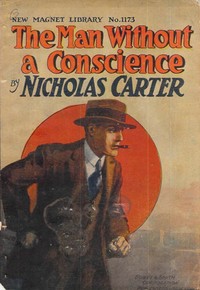
The Man Without a Conscience; Or, From Rogue to Convict — Inside the Classic
Adventure Picaresque Fiction
46,521 recorded words. 29 minutes difference from this book's estimate.
View Gutenberg source #63864
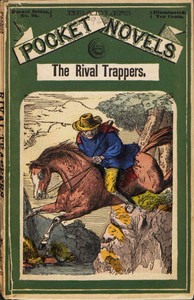
For The Rival Trappers: or, Old Pegs, The Mountaineer — Reading Companion, the stored edition analysis reports 39,921 words, 2 hr 54 min estimated reading time, and 5 detected text sections.
The text analysis averages about 15.9 words per sentence, while the detected sections provide another way to judge how the source is divided.
Project Gutenberg metadata also associates the work with “Frontier and pioneer life -- Fiction,” connecting these edition facts with the source record’s subject description.
Explore this collection
These alternatives are selected using recorded categories and estimated reading time.
About 203 minutes
Adventure Picaresque Fiction
46,521 recorded words. 29 minutes difference from this book's estimate.
View Gutenberg source #63864About 140 minutes
Adventure Picaresque Fiction
32,160 recorded words. 34 minutes difference from this book's estimate.
View Gutenberg source #66996About 210 minutes
Adventure Picaresque Fiction
48,284 recorded words. 36 minutes difference from this book's estimate.
View Gutenberg source #62010Search stored excerpts and compare books → Choose by your preferences →
Choices use stored catalog measurements. Estimates vary with reading speed. A shared category is a catalog label, not a claim that two books have the same argument or literary quality.
Search reads excerpt text stored with this catalog and links to its associated Gutenberg record. The connection is stored in the site database; this tool does not recheck that every excerpt is word-for-word identical to that external record. Excerpt search does not cover every chapter and does not verify historical publication dates.
Catalog snapshot checked: 2026-09-25. Coverage: 92 public books, 92 available source excerpts.
Calculated from edition completeness, EPUB availability, text structure and catalogue metadata. Not a user rating.
Total of 100 points, scaled to a 2.5-5.0 range. Editions with an empty description or a missing EPUB file are not scored.
Public-domain source text
The source text is kept in the dedicated reader, separate from this catalogue record and its commentary.
The opening of The Rival Trappers introduces its title character through a deliberately exaggerated physical portrait. Old Pegs is described as having “the body of a giant, set upon a pair of legs so crooked and misshapen” that they seem borrowed, and his gait is “sidelong, hitching” yet efficient. The narrator lingers on his “ludicrous ‘make-up’” before revealing his “high forehead, merry brown eyes and smiling mouth,” a sequence that builds curiosity before confirming his competence. This technique of delaying positive traits establishes a pattern: the novel often uses comic or grotesque first impressions to heighten later demonstrations of skill or courage.
The dialogue in the excerpts is marked by a distinct vernacular that varies between characters. Old Pegs’s speech is peppered with self-deprecating humor and dialectal contractions: “Hyar we come and hyar we go, pegging along the canon.” His phrasing, such as “ez long ez I am happy ez a buck Digger in grasshopper time,” blends folksy simile with a rhythmic, almost sung quality. In contrast, the later scene with Captain Dave Farrell and his men uses a more clipped, urgent tone: “I want a trailer—one who will track these dogs to their den.” The shift from Old Pegs’s whimsical monologue to the terse commands of the borderers marks a change in narrative pace, from character introduction to plot-driven action. The author uses dialect not merely for color but to signal social roles: Old Pegs’s eccentricity, the men’s frontier practicality.
The night attack sequence demonstrates a deliberate control of pacing. The narrative slows to describe the “wavering” spots on the grass and the metallic gleam in moonlight, building tension through the guards’ uncertainty. The sentence “Dave uttered a low exclamation, and caught the guard by the arm” accelerates the rhythm, followed by the revelation: “There they come, by heaven!” The author then pauses again to enumerate the attackers—Velveteens, the flogged men, the Modoc Sioux—before the signal shot. This alternation between close observation and sudden action is a hallmark of the dime novel’s adventure style. The prose also uses short, exclamatory lines (“Hark! They are gathering for the rush now”) to mimic the breathlessness of the moment, a technique that contrasts with the more leisurely descriptive passages earlier in the book.
Physical description in the excerpts carries thematic weight beyond mere characterization. Old Pegs’s deformed legs and “herculean arms” establish him as a figure of incongruity—powerful yet misshapen—which may reflect the novel’s interest in outward appearance versus inner worth. Later, the trappers are described as “a sprinkling of all nationalities” with “youthful faces” marked by “the wild life of the border.” This collective portrait emphasizes a shared hardness earned through experience. The repeated attention to weapons—Old Pegs’s “carefully-polished rifle,” the men’s revolvers and knives—serves as a shorthand for readiness and danger. Even the setting is rendered through sensory details: the “mellow radiance” of the moon, the “short prairie grass” behind which enemies crawl. These recurring elements create a consistent visual and tactile world, grounding the melodrama in concrete, physical reality.
The chapter titles hint at a deliberate alternation between character-focused and action-driven segments. “Old Pegs” and “Old Pegs’ Treasure” suggest an initial emphasis on the protagonist’s eccentricity and possessions, while later titles like “A Border Battle” and “A Dreadful Ordeal” signal escalating conflict. The excerpts show this shift in practice: the first chapter’s leisurely description of Old Pegs’s appearance and self-mocking song gives way to the terse, violent language of the camp scene. The author also varies sentence length to match mood—long, compound sentences for description, short staccato ones for action. This structural awareness suggests a writer attuned to the rhythms of serial publication, where each chapter must offer a distinct hook while advancing the larger narrative.
Readers attentive to narrative voice will notice how the novel’s tone oscillates between the comic grotesque and the grimly violent, a range that reflects the dime novel’s appetite for variety. The excerpts offer only a partial view of the plot, but they reveal a consistent craft in pacing and character introduction. Pay particular attention to how the author handles transitions between scenes of dialogue and action, and how physical description is used to telegraph moral qualities.
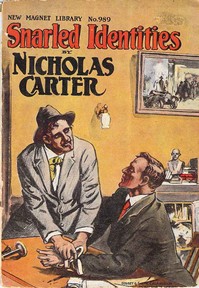
That night attack sequence kept circling back to me—how the mountaineer's stillness before the chaos said more than any shout. I found a similar ache in Snarled Identities; Or, A Desperate Tangle — Context and Discussion, where the tangle isn't just action but the quiet confusion underneath. It made me think of how we hold our own contradictions, waiting, the way Old Pegs did.
Answer a few questions and save a private reflection on this device.