About 515 minutes
Lady Athlyne — Key Ideas to Explore
Historical Psychological Social Fiction
118,259 recorded words. 1 minutes difference from this book's estimate.
View Gutenberg source #65799
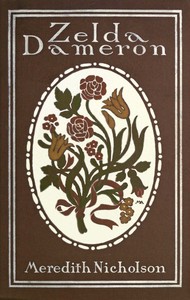
The catalog record for Zelda Dameron — Reading Companion provides practical reading context through 118,079 words, 8 hr 34 min estimated reading time, and 47 detected text sections.
The text analysis averages about 15.4 words per sentence, while the detected sections provide another way to judge how the source is divided.
Project Gutenberg metadata also associates the work with “City and town life -- Fiction,” connecting these edition facts with the source record’s subject description.
Explore this collection
These alternatives are selected using recorded categories and estimated reading time.
About 515 minutes
Historical Psychological Social Fiction
118,259 recorded words. 1 minutes difference from this book's estimate.
View Gutenberg source #65799About 523 minutes
Historical Psychological Social Fiction
120,230 recorded words. 9 minutes difference from this book's estimate.
View Gutenberg source #62184About 548 minutes
Historical Psychological Social Fiction
125,849 recorded words. 34 minutes difference from this book's estimate.
View Gutenberg source #68503Search stored excerpts and compare books → Choose by your preferences →
Choices use stored catalog measurements. Estimates vary with reading speed. A shared category is a catalog label, not a claim that two books have the same argument or literary quality.
Search reads excerpt text stored with this catalog and links to its associated Gutenberg record. The connection is stored in the site database; this tool does not recheck that every excerpt is word-for-word identical to that external record. Excerpt search does not cover every chapter and does not verify historical publication dates.
Catalog snapshot checked: 2026-09-25. Coverage: 92 public books, 92 available source excerpts.
Calculated from edition completeness, EPUB availability, text structure and catalogue metadata. Not a user rating.
Total of 100 points, scaled to a 2.5-5.0 range. Editions with an empty description or a missing EPUB file are not scored.
Public-domain source text
The source text is kept in the dedicated reader, separate from this catalogue record and its commentary.
The novel begins not with Zelda Dameron herself, but with her being discussed: Mrs. Forrest remarks to her brother that Zelda is “like Margaret; she’s really one of us,” immediately situating the young woman within a family legacy. The opening scene—a crowded drawing-room where Zelda has just arrived from a five-year absence—establishes a world of social performance and whispered judgments. Rodney Merriam’s hope that she has “escaped the Dameron traits” hints at a family reputation that will shadow her return.
Nicholson’s prose is economical, using dialogue and gesture to convey character. The early chapters move between public gatherings and private conversations, gradually revealing the town of Mariona as a place where past grievances and financial interests intertwine. The reader is invited to watch Zelda navigate this landscape, her own thoughts largely withheld in the opening pages.
The first chapter presents Zelda almost entirely through the perceptions of her aunt and uncle. Mrs. Forrest’s comparison to Margaret—Zelda’s mother—and Rodney Merriam’s wary hope that she has avoided “the Dameron traits” establish a family narrative before Zelda speaks. The reader sees her profile, her manner with other girls, and the deference she receives, but not her interior life. This technique continues in later excerpts: when Jack Balcomb discusses Ezra Dameron, he describes the old man as “a queer old party, with a chilly manner and an alluring smile,” again filtering character through another’s judgment.
This indirect presentation invites the reader to piece together Zelda’s identity from the reactions she provokes. The opening chapters function as a series of portraits drawn by those around her, each revealing more about the observer than the observed. Nicholson uses this method to build suspense around Zelda’s own intentions and feelings, which remain partially obscured well into the narrative.
Nicholson grounds the story in the specific rhythms of a Midwestern town at the turn of the century. The opening party at Mrs. Carr’s, with its “great murmur” of voices and stringed instruments struggling above, establishes a setting where social performance is paramount. Later, Jack Balcomb’s office—with its file drawers labeled “Greene County Coal,” “Cement Reports,” and “U. S. Treasurer”—reveals a world of business where appearances are carefully managed. Balcomb’s theatrical display of gloves and whisky, drawn from drawers with misleading labels, underscores the gap between public facade and private reality.
The town of Mariona itself is characterized by its reliance on reputation: “the tradition of riches is almost as good as the proved fact,” Nicholson writes. This observation about Ezra Dameron’s wealth applies broadly to the social dynamics of the novel, where what is believed about a person often carries more weight than what is known. The reader is encouraged to attend to these layers of perception and misperception.
Ezra Dameron, Zelda’s father, is a figure of considerable power in the novel, yet he appears in the excerpts primarily through others’ accounts. He is described as a miser, a hard man, and the subject of conflicting opinions: some call him “an ugly blackguard,” while others believe his wife’s family mistreated him. The narrator notes that “his way of living was not attractive to sane, reasonable people,” but refrains from direct judgment. This ambiguity is central to the novel’s exploration of character and reputation.
When Balcomb prepares to visit Ezra, he treats the encounter as a performance, choosing his gloves and fortifying himself with whiskey. The old man’s “chilly manner and an alluring smile” suggest a complexity that resists easy categorization. Nicholson builds Ezra Dameron as a figure whose true nature remains elusive, inviting the reader to weigh the various testimonies and form their own conclusions as the story unfolds.
Financial concerns permeate the novel’s early chapters. The opening conversation touches on Margaret Dameron’s estate, valued at four hundred and fifty thousand dollars by the conservative lawyer Copeland. Ezra’s own wealth is a matter of speculation, and the narrative notes that “it had been said for years that Ezra Dameron was the possessor of great wealth.” This uncertainty about actual versus perceived wealth drives much of the plot’s tension.
Balcomb’s business schemes—his talk of increasing capital stock and his manipulation of Van Cleve—introduce a world where money is both a tool and a weapon. The chapter titles themselves, such as “A Polite Request for Money” and “Dameron Block, 1870,” signal the centrality of financial transactions and property. Nicholson weaves these economic threads into the social fabric, suggesting that in Mariona, personal relationships are inseparable from financial ones. The reader should watch how characters’ attitudes toward money reveal their values and vulnerabilities.
As you read Zelda Dameron, pay attention to the gaps between what characters say and what they do, and between what is known and what is merely rumored. Nicholson’s narrative rewards careful attention to dialogue and detail, where a seemingly casual remark may carry the weight of family history. The novel’s structure—moving from public scenes to private conversations—mirrors the process of uncovering truth in a community built on appearances. Let the early chapters establish the questions that will drive the story forward.
There’s something about Zelda returning to Mariona, to all those half-finished conversations and watchful faces, that reminds me how old stories keep their quiet grip on us. I found myself thinking of that feeling again while reading the notes on Deep Waters. The same current runs beneath it, I think—that pull of things left unsaid, lingering in the margins of a town’s memory. Deep Waters; Or, A Strange Story — Edition Insights feels like an old friend’s hand on the page, holding the door open just a crack.
Create a short personal record of your experience with this book.