About 152 minutes
Mr. Carteret and Others — Key Ideas to Explore
Historical Psychological Social Fiction
34,828 recorded words. 1 minutes difference from this book's estimate.
View Gutenberg source #68051
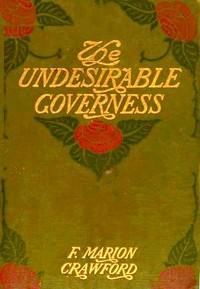
The Undesirable Governess — Story, Setting & Ideas can be approached with a clearer sense of reading commitment from its source measurements: 35,164 words, 2 hr 33 min estimated reading time, and 5 detected text sections.
The text analysis averages about 17.9 words per sentence, while the detected sections provide another way to judge how the source is divided.
Project Gutenberg metadata also associates the work with “Governesses -- Fiction,” connecting these edition facts with the source record’s subject description.
Explore this collection
These alternatives are selected using recorded categories and estimated reading time.
About 152 minutes
Historical Psychological Social Fiction
34,828 recorded words. 1 minutes difference from this book's estimate.
View Gutenberg source #68051About 160 minutes
Historical Psychological Social Fiction
36,621 recorded words. 7 minutes difference from this book's estimate.
View Gutenberg source #67543About 165 minutes
Historical Psychological Social Fiction
37,845 recorded words. 12 minutes difference from this book's estimate.
View Gutenberg source #65566Search stored excerpts and compare books → Choose by your preferences →
Choices use stored catalog measurements. Estimates vary with reading speed. A shared category is a catalog label, not a claim that two books have the same argument or literary quality.
Search reads excerpt text stored with this catalog and links to its associated Gutenberg record. The connection is stored in the site database; this tool does not recheck that every excerpt is word-for-word identical to that external record. Excerpt search does not cover every chapter and does not verify historical publication dates.
Catalog snapshot checked: 2026-09-25. Coverage: 92 public books, 92 available source excerpts.
Calculated from edition completeness, EPUB availability, text structure and catalogue metadata. Not a user rating.
Total of 100 points, scaled to a 2.5-5.0 range. Editions with an empty description or a missing EPUB file are not scored.
Public-domain source text
The source text is kept in the dedicated reader, separate from this catalogue record and its commentary.
The novel opens not with the governess but with a marital standoff over tea. Colonel Follitt's mild 'By-the-bye' and Lady Jane's 'armed neutrality' establish a household where every syllable carries weight. Crawford's narrator immediately undercuts the Colonel's military career by noting he 'was a mild man' who preferred feminine society—a trait his wife finds a 'serious grievance.' This early tension between surface decorum and private irritation sets the pattern for the entire work.
The excerpts reveal a story told through brisk, often ironic narration that shifts between characters' perspectives. The governess Ellen is introduced not through description but through her strategic thinking: she plans to 'redden my nose and go lame again' to maintain her undesirable status. The narrative voice moves fluidly from the Colonel's tea-stirring to Ellen's calculated self-presentation, creating a layered comedy of social performance.
Crawford's dialogue is a weapon of indirection. The opening exchange between Colonel and Lady Jane Follitt is a masterclass in marital sparring: his single 'Oh' is parsed as an accusation, her retort 'I know very well what you meant' reveals a long history of unspoken grievances. The narrator steps in to clarify that the Colonel 'took it sweet, with cream'—a detail that deflates his military gravitas while underscoring his domestic passivity.
Later, when Ellen and Lionel discuss her departure, the conversation becomes a dance of evasion. Lionel's repeated questions—'Which would you rather do?'—expose his 'moral timidity,' a trait the narrator explicitly links to the Follitt family. Ellen's reply, 'I should like you to make up my mind for me,' is both a romantic gambit and a tactical retreat. Crawford lets the subtext do the work: the reader senses the proposal before Lionel voices it.
Crawford's narrator frequently breaks the fourth wall to comment on character psychology, often with dry humor. When describing the Follitts' moral courage, the narrator observes that 'people with noble qualities are sometimes very hard to live with' and that 'superior individuals who have no moral timidity rarely hesitate to show us what poor creatures we really are.' This generalization frames the family's flaws as endearing rather than contemptible.
Similarly, the narrator notes that Lady Jane's 'genuine affection was tempered by a wholesome dread'—a phrase that encapsulates the family dynamics. These asides create a conspiratorial tone, inviting the reader to share in the narrator's amused detachment. They also serve to pace the story, slowing down moments of tension to allow for reflection, then accelerating back into action.
Crawford controls narrative speed by repeating key phrases with slight variations. The word 'undesirable' recurs as a motif: Ellen is initially 'undesirable,' then 'ceased to be undesirable,' and the comedy hinges on her maintaining that status. This repetition creates a rhythmic structure, like a musical theme.
Scenes alternate between rapid-fire dialogue and extended narrative commentary. The tea-table opening is brisk, with short paragraphs and clipped lines. In contrast, the later scene on the moorland road unfolds slowly, with long paragraphs describing the setting—'the rock by the moorland road'—and the characters' internal deliberations. Crawford uses physical details (the trout pool, the knoll) to anchor these reflective pauses, then jolts the pace with a decisive line like 'We must be married in June.'
Readers will find that Crawford's novel rewards attention to its verbal textures: the way a single word like 'oh' can carry a chapter's worth of marital history, or how a narrator's aside can transform a domestic squabble into a commentary on human nature. The excerpts suggest a work that is both a comedy of manners and a study in strategic self-presentation. Pay close attention to what characters do not say—the silences, the half-finished sentences—for they often speak louder than the dialogue itself.
Reading about Crawford’s governess, I remembered my own first days in a strange household, that quiet arithmetic of usefulness. The Undesirable Governess made me think of the patient way we reshape ourselves for approval. The Little French Girl — A Reader’s Guide held that same soft ache of belonging, a feeling I’d nearly forgotten until now.
Your answers remain private and are stored only in this browser.