About 165 minutes
Porgy — A Closer Reading
Historical Psychological Social Fiction
37,845 recorded words. 5 minutes difference from this book's estimate.
View Gutenberg source #65566
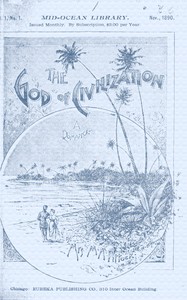
The God of Civilization: A Romance — Background and Themes can be approached with a clearer sense of reading commitment from its source measurements: 36,621 words, 2 hr 40 min estimated reading time, and 24 detected text sections.
The text analysis averages about 20.5 words per sentence, while the detected sections provide another way to judge how the source is divided.
Project Gutenberg metadata also associates the work with “Love stories,” connecting these edition facts with the source record’s subject description.
Explore this collection
These alternatives are selected using recorded categories and estimated reading time.
About 165 minutes
Historical Psychological Social Fiction
37,845 recorded words. 5 minutes difference from this book's estimate.
View Gutenberg source #65566About 153 minutes
Historical Psychological Social Fiction
35,164 recorded words. 7 minutes difference from this book's estimate.
View Gutenberg source #62317About 152 minutes
Historical Psychological Social Fiction
34,828 recorded words. 8 minutes difference from this book's estimate.
View Gutenberg source #68051Search stored excerpts and compare books → Choose by your preferences →
Choices use stored catalog measurements. Estimates vary with reading speed. A shared category is a catalog label, not a claim that two books have the same argument or literary quality.
Search reads excerpt text stored with this catalog and links to its associated Gutenberg record. The connection is stored in the site database; this tool does not recheck that every excerpt is word-for-word identical to that external record. Excerpt search does not cover every chapter and does not verify historical publication dates.
Catalog snapshot checked: 2026-09-25. Coverage: 92 public books, 92 available source excerpts.
Calculated from edition completeness, EPUB availability, text structure and catalogue metadata. Not a user rating.
Total of 100 points, scaled to a 2.5-5.0 range. Editions with an empty description or a missing EPUB file are not scored.
Public-domain source text
The source text is kept in the dedicated reader, separate from this catalogue record and its commentary.
The novel opens with Mabel Miller's complaint of being "sick of it all"—parties, calls, and theatre—a restlessness that her father promptly answers with a trip to Australia. This blunt, dialogue-driven start establishes a pattern: characters voice dissatisfaction directly, and action follows swiftly. The story's structure, serialized in the Mid-Ocean Library, mirrors its thematic concern with movement between worlds—from San Francisco drawing rooms to a "flower embowered kingdom of the sea."
Yet the romance's title, The God of Civilization, hints at irony. While Mabel seeks novelty abroad, the excerpts show a parallel domestic drama: Harry Howard, a married man, lies to his wife Lucy about going to the club, then visits a florist and a house where "an air of freedom" marks women who need no chaperone. The text thus sets up a contrast between the promised adventure of travel and the familiar betrayals of home.
The excerpts rely heavily on unadorned dialogue to convey character and conflict. Mabel's opening exclamation—"Oh! I have grown so tired of this continual round"—is answered by her cousin Lucy's practical rebuttal, then by her father's offer of a voyage. No narrator intervenes to interpret; the reader hears the discontent directly. Similarly, Harry Howard's conversation with Rosie Hastings unfolds in quick exchanges: "You are a perfect jewel, Mr. Howard," she says, and he replies, "to please you, what would I not do." The dialogue carries the weight of characterization—Mabel's impulsiveness, Harry's flattery, Lucy's silent grief. This technique gives the novel a theatrical quality, as if scenes are meant to be overheard rather than described.
The plot offers two contrasting escapes. Mabel's father proposes a literal journey to Australia, a chance to break monotony. The trip is framed as wholesome novelty—a chance to see new places and learn crafts like mat-weaving and hat-making. In contrast, Harry Howard's escape is moral: he leaves his wife Lucy after a quarrel, claiming to go to the club, but instead visits a florist and then a house where dancing lasts "well into the morning hours." The text juxtaposes these escapes without comment, letting the reader weigh Mabel's open adventure against Harry's covert pleasures. Both characters seek relief from dissatisfaction, but the novel's moral landscape remains ambiguous.
Amid the lively dialogue and travel plans, a quieter scene stands out. After Harry leaves, Lucy goes to her baby's room, "throwing herself on her knees" and sobbing, "oh baby, you do not know how wretched I am." This moment is the only interior view of a character's emotional pain. Lucy's grief is private, unspoken to anyone else—a contrast to Mabel's voiced complaints and Harry's performative charm. The baby, described as a "frail little pet," becomes a silent recipient of her despair. The scene hints at a domestic tragedy that the romance plot may or may not resolve. The excerpts do not reveal Lucy's fate, but her kneeling posture and wish to die suggest a depth of suffering the lighter scenes avoid.
Readers should attend to the novel's structural parallels: Mabel's journey outward and Harry's deceptions inward both stem from a restlessness the text neither fully condemns nor endorses. The excerpts offer no resolution for Lucy's anguish or Mabel's adventure, leaving the romance's moral trajectory open. Pay attention to how the narrator withholds judgment, letting dialogue and action speak for themselves—a technique that makes The God of Civilization a study in contrasts rather than a simple tale.
Reading about that heiress’s Pacific restlessness, I remembered a summer of similarly heavy quiet at my grandmother’s, where every room felt like a choice I hadn’t made. The Castlecourt Diamond Mystery — Key Ideas to Explore once brought back that same ache, its stolen gem less a plot than a mirror for all the things we hide behind closed doors.
Save your reaction, strongest insight, and memorable passage.