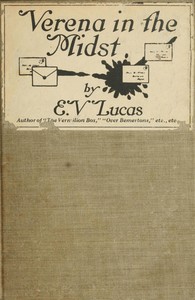
Verena in the Midst: A Kind of a Story — Inside the Classic

(0 User reviews)   971
Lucas, E. V. (Edward Verrall), 1868-1938 Project Gutenberg 2020 Not confirmed
Epistolary fiction; England -- Social life and customs -- 20th century -- Fiction; Invalids -- Fiction Readers of public-domain and historical texts
Project Gutenberg digital edition en

Edition facts

Words 56,190
Reading time 245 min
Text sections 167

Before opening Verena in the Midst: A Kind of a Story — Inside the Classic, the edition data offers a quick orientation: 56,190 words, 4 hr 5 min estimated reading time, and 167 detected text sections.

The text analysis averages about 19.6 words per sentence, while the detected sections provide another way to judge how the source is divided.

Project Gutenberg metadata also associates the work with “Epistolary fiction,” connecting these edition facts with the source record’s subject description.

An epistolary novel set in 1919, centered on the convalescent Verena Raby and her correspondent Richard Haven, whose letters debate charity, family duty, and the aftermath of war with a dry, conversational wit.
Share
Editorial Edition Score 4.8/5

Calculated from edition completeness, EPUB availability, text structure and catalogue metadata. Not a user rating.

How this score is calculated
  • Description quality20 pts
  • Title & short description10 pts
  • Source metadata20 pts
  • Text length15 pts
  • Chapters / structure15 pts
  • EPUB file integrity20 pts

Total of 100 points, scaled to a 2.5-5.0 range. Editions with an empty description or a missing EPUB file are not scored.

Edition quality

Read the Text

ow returned to Kensington routine, in a not too congenial home. Her brother Roy also finds Peace heavy on his hands but has more chances for liberty and diversion, and grasps most of them.

Evangeline Barrance, a sister still at school, is one of the youngest editors in Europe.

Mr. Horace Mun-Brown, Miss Raby’s nephew and a briefless barrister, lives in the Temple on a small income and a sanguine disposition.

Mr. Septimus Tribe, the husband of Verena’s youngest sister, Letitia, and by some years her senior, was at the Board of Trade, but is now in retirement at Tunbridge Wells.

Clemency Power is an Irish girl who managed to get out to France during the War, although under age, and was so happy and busy there that she abandoned idleness permanently. Her mother, a widow, the daughter of an Irish peer, lives with Clemency’s two younger sisters near Kenmare. Patricia, aged nineteen, is the only one who comes into this correspondence.

Miss Louisa Parrish, who was at school with Verena and looks upon that accident as an indissoluble bond, lives frugally but with no loss of social position in her late father’s house in a Berkshire village.

Nicholas Devose is a traveller and artist who came nearer marrying Verena Raby than any other man has done.

Bryan Field is a young doctor whose path crossed that of Clemency Power in France during the War.

Sir Smithfield Mark is one of the leading surgeons at Bart’s.

Sinclair Ferguson is Miss Raby’s doctor.

Lady Sandys is a neighbour of the Rossiters in Kent.

Vincent Frank is remaining in the R.A.F. although the War is over.

Mrs. Carlyon, whom we meet at once, only to lose her again, is a neighbour of Miss Raby at Kington.

RHODA CARLYON TO NESTA ROSSITER

Miss Raby has had an accident and has asked for you. No immediate danger. Hope you can come quickly.

RHODA CARLYON TO RICHARD HAVEN

DEAR MR. HAVEN,—I am sorry to have rather bad news for you. My neighbour, Miss Raby, has had the misfortune to fall and hurt her spine, and Mr. Ferguson, our doctor, is afraid that she may have to lie up for some long time. She is not in much pain, but must be very quiet. She was anxious that you should be told. It was fortunate that I was at home when the accident happened, as her maids are not good in emergencies. Mr. Ferguson, who is exceptionally capable for a country place, will call in a specialist, but I fear there is no doubt about the seriousness of the injury and that her recovery will be a long business. Miss Raby is very brave and even smiling over it, but for anyone so active and so much interested in the life around her it will be a trial. She is hoping for one of her nieces, Mrs. Rossiter, to come directly.—I am, yours sincerely,

RICHARD HAVEN TO VERENA RABY

DEAREST VERENA, your letter—or rather Mrs. Carlyon’s, containing your bad news—gave me a shock. Do you really mean to say you will have to lie up for months—flat and helpless? This is terrible for you—and for us. Of course I shall come and see you as soon as may be; but it can’t be yet. Why do you live so far away? And I will write, but if you cannot use your hands you must get either Mrs. Carlyon or Nesta (if she is there) to answer a number of questions at once. (I am glad Nesta is coming.)

(a) Can you use your hands?

(b) Does it tire you too much to read?

(c) Have you much or any pain?

(d) What can I do for you first?

(e) Have you a library subscription?

(f) Is there anyone in the neighbourhood who can read aloud, endurably?

(g) (Don’t worry: you are not to have the whole alphabet.) Do games of solitaire appeal to you?

I want you to think of me as your Universal Provider and to express your needs without any reserve. For what else am I useful? Consider me, in short, as a Callisthenes whose motto is “Deeds not Words.”—Yours,

_P.S._—(h) Have you a gramophone? And if not, does the idea of a gramophone repel or attract?

_P.S. 2._—DEAREST VERENA, I hate it that you should be ill—you who live normally a hundred minutes to the hour. But if there is no heritage of weakness you will be all the better for the enforced rest. That I intend to think and believe.

_P.S. 3._—Yours, again and always,

FROM THE “HEREFORDSHIRE POST”

The reader is introduced to Verena Raby through a prefatory note that sketches her as the centre of an epistolary circle, an invalid reigning over Old Place in Herefordshire. The correspondence, set in 1919, begins with Richard Haven’s letters, which immediately establish a tone of frank, self-deprecating argument. In one early excerpt, Haven declines to fund a tippling doctor, reasoning that a bribe is offensive and that expulsion might jolt the man into reform—or ruin him entirely. He weighs consequences with a lawyer’s care, then pivots to the League of Nations and the folly of building above ground. This blend of moral casuistry, domestic ethics, and wry pessimism sets the novel’s conversational rhythm.

A Correspondence of Moral Calculus

The excerpts reveal a novel built on extended ethical debates conducted by post. Haven’s letter about the alcoholic doctor is a miniature essay: he rejects simple charity, speculates on the doctor’s pride, and worries that teetotalism might breed self-righteousness. He concludes that the wife will suffer regardless, and advises Verena to help her instead. This is not a plot point but a sample of the book’s method—characters think aloud about obligation, fairness, and unintended consequences. The reader should expect few dramatic events; the drama lies in the shifting weights of argument.

Verena’s Voice in the Midst

When Verena replies, her tone is softer but no less thoughtful. She thanks Haven for his promptness, then turns to her own concerns: how to dispose of money after death, whether to help needy relatives now, and the case of her nephew Roy, who falls in and out of love. She envies the young their “inconstancy” and laments the cautions of age. Her letters are less combative than Haven’s, but they share his habit of turning practical questions into reflections on human nature. The reader sees her as the still centre around which these moral inquiries revolve.

The Texture of 1919

The novel is saturated with the mood of its year. Haven mentions building underground because war will be waged in the air; he quotes Chinese poems that haunt him. The prefatory note lists characters—Nesta Rossiter managing Old Place, Emily Goodyer engaged to a greengrocer-soldier—but the excerpts focus on abstract talk. The reader should attend to how the war shadows every discussion, even when unstated. The epistolary form allows Lucas to capture a specific historical moment through private reflection rather than public event.

Reading Between the Letters

Because the excerpts are incomplete, the reader must infer the larger story from fragments. The novel’s subtitle, “A Kind of a Story,” signals that plot is secondary to character and conversation. The letters do not advance a single narrative; they accumulate. The reader is advised to treat each letter as a self-contained meditation, and to watch for recurring concerns—money, health, family duty, the limits of intervention. The pleasure lies in the precision of the prose and the subtle shifts in relationship between the two correspondents.

The excerpts offer a clear entry point: read for the voice, not the plot. Haven’s blend of cynicism and tenderness, Verena’s gentle irony, and the constant pressure of a world recovering from war give the letters their texture. The novel rewards attention to small arguments and offhand quotations. Approach it as a series of conversations with a friend who thinks aloud.

Reading Verena's letters made me think of my grandmother’s quiet afternoons, sorting photographs and talking to no one. Her opinions were like Verena’s—sharp, yet shaded with a strange tenderness for what she had lost. The Real Lady Hilda: A Sketch — A Reader’s Guide gave me a similar feeling, as if I were overhearing a life lived just behind a closed door.

There are no reviews for this eBook.

0
0 out of 5 (0 User reviews )

Add a Review

Your Rating *
There are no comments for this eBook.

Reader reflection

Your personal reading reflection

Build a private reading journal entry for this title.

Your progress 0 / 10
1

Which reading stage best describes you?

2

How did the book work for you overall?

3

Would you recommend this book to another reader?

4

How demanding did the text feel?

Related eBooks