About 170 minutes
Blotted Out — Inside the Classic
Historical Psychological Social Fiction
39,034 recorded words. 0 minutes difference from this book's estimate.
View Gutenberg source #67411
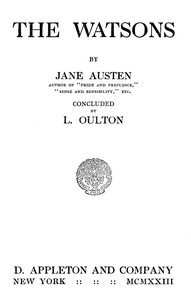
The Watsons: By Jane Austen, Concluded by L. Oulton — A Closer Reading can be approached with a clearer sense of reading commitment from its source measurements: 39,040 words, 2 hr 50 min estimated reading time, and 4 detected text sections.
The text analysis averages about 19.5 words per sentence, while the detected sections provide another way to judge how the source is divided.
Project Gutenberg metadata also associates the work with “England -- Social life and customs -- 19th century -- Fiction,” connecting these edition facts with the source record’s subject description.
Explore this collection
These alternatives are selected using recorded categories and estimated reading time.
About 170 minutes
Historical Psychological Social Fiction
39,034 recorded words. 0 minutes difference from this book's estimate.
View Gutenberg source #67411About 169 minutes
Historical Psychological Social Fiction
38,821 recorded words. 1 minutes difference from this book's estimate.
View Gutenberg source #64892About 165 minutes
Historical Psychological Social Fiction
37,845 recorded words. 5 minutes difference from this book's estimate.
View Gutenberg source #65566Search stored excerpts and compare books → Choose by your preferences →
Choices use stored catalog measurements. Estimates vary with reading speed. A shared category is a catalog label, not a claim that two books have the same argument or literary quality.
Search reads excerpt text stored with this catalog and links to its associated Gutenberg record. The connection is stored in the site database; this tool does not recheck that every excerpt is word-for-word identical to that external record. Excerpt search does not cover every chapter and does not verify historical publication dates.
Catalog snapshot checked: 2026-09-25. Coverage: 92 public books, 92 available source excerpts.
Calculated from edition completeness, EPUB availability, text structure and catalogue metadata. Not a user rating.
Total of 100 points, scaled to a 2.5-5.0 range. Editions with an empty description or a missing EPUB file are not scored.
Public-domain source text
The source text is kept in the dedicated reader, separate from this catalogue record and its commentary.
The surviving fragment of The Watsons breaks off mid-scene, leaving the narrative suspended at a dinner party where seating arrangements become a battlefield of social rank and romantic interest. The manuscript, as James Edward Austen-Leigh notes in his preface, was left without chapter divisions and bears marks of an early, unpolished stage. Yet even in this incomplete state, the work displays Austen's characteristic method of advancing character and conflict through dialogue and minute social transactions rather than authorial summary.
The text presents an unusual editorial situation: Jane Austen's unfinished manuscript, composed around 1803–1804, is here completed by L. Oulton, whose contribution begins after the fragment's abrupt end. The preface by James Edward Austen-Leigh establishes that the original lacks chapter divisions and contains 'obscurities and inaccuracies of expression' the author would have corrected. Readers encounter a work in two distinct layers—Austen's taut, ironic social observations and Oulton's attempt to resolve the dangling plotlines. The transition between the two is not marked in the body text, making the shift in style and pacing a point of interest for those familiar with Austen's mature voice.
The excerpt from the dinner party at Mr. Howard's reveals how seating functions as a coded language of preference and exclusion. Emma Watson is displaced from her chair beside Mr. Howard when Miss Osborne and Miss Carr arrive; Miss Osborne 'at once took possession of the chair at Mr. Howard's right hand, which had previously been occupied by Emma.' The physical rearrangement mirrors the social hierarchy: Lord Osborne's sister and her friend assert their superior rank by claiming proximity to the host. Tom Musgrave's 'assiduous' attention to Miss Carr and his whispered negotiation to be her 'cavalier at the next meet' further illustrate how the table becomes a space for strategic alliance-building. Emma, left to share Lord Osborne with the child Charles, is effectively sidelined—a position that underscores her family's lower standing.
Throughout the fragment, characters are repeatedly placed in situations where they must navigate public scrutiny. Emma's discomfort at the dinner is compounded by Miss Carr's pointed remark that the castle is 'thrown open to the public every Wednesday—all except the private apartments,' a comment that reduces Emma to a tourist in her own social sphere. The image of the 'stuffed fox' that Charles eagerly wants to show her introduces a note of grotesque domestic display, contrasting with the polished manners of the adults. Later, when Lord Osborne awkwardly asserts himself by saying 'Lady Osborne will wait on Miss Watson,' the narrative notes that 'Miss Osborne stared at her brother, but there was something in his face that compelled her to lower her eyes.' This moment of silent authority hints at tensions within the Osborne family that the fragment does not develop.
The action in the surviving portion shifts between the Edwards' house, the dinner party, and the carriage ride home, each space carrying distinct social rules. The carriage journey at the end of the excerpt—'Mr. Watson asked to return home—declining to wait for supper—and took leave with his daughters'—marks a retreat from the public performance of the dinner to the private sphere of family. Mr. Howard's act of conducting them to the carriage and Emma's curtsy 'in passing him' suggest a ritualized leave-taking that preserves decorum while hinting at unspoken connection. The fragment's abrupt halt leaves this movement unresolved, making the reader acutely aware of the missing scenes that would have completed the social geography of the novel.
Readers approaching The Watsons should attend to the fragment's unfinished quality as a feature, not a flaw. The abrupt break invites speculation about Austen's intentions, while Oulton's continuation offers one possible resolution. Comparing the two authors' handling of dialogue, pacing, and character motivation can illuminate the distinctive qualities of Austen's craft. The work rewards close attention to its small, telling details—a chair taken, a bow given, a fox stuffed and displayed.
I’ve spent many evenings with the Watsons, watching their careful seating at someone else’s table, that silent arithmetic of place and love. It reminds me of the quiet world within Legend — A Reader’s Guide, where every gesture echoes with unspoken consequence. Both are homes where standing still says more than shouting ever could. A gentle, knowing intimacy, lasting years.
Your answers remain private and are stored only in this browser.