About 217 minutes
The Master Rogue: The Confessions of a Croesus — Key Ideas to Explore
Historical Psychological Social Fiction
49,772 recorded words. 12 minutes difference from this book's estimate.
View Gutenberg source #67089
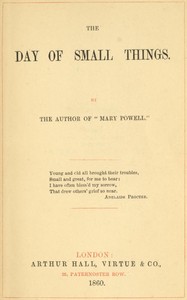
Before opening The Day of Small Things — Background and Themes, the edition data offers a quick orientation: 47,061 words, 3 hr 25 min estimated reading time, and 6 detected text sections.
The text analysis averages about 18.3 words per sentence, while the detected sections provide another way to judge how the source is divided.
Project Gutenberg metadata also associates the work with “Country life -- England -- Fiction,” connecting these edition facts with the source record’s subject description.
Explore this collection
These alternatives are selected using recorded categories and estimated reading time.
About 217 minutes
Historical Psychological Social Fiction
49,772 recorded words. 12 minutes difference from this book's estimate.
View Gutenberg source #67089About 225 minutes
Historical Psychological Social Fiction
51,590 recorded words. 20 minutes difference from this book's estimate.
View Gutenberg source #63775About 170 minutes
Historical Psychological Social Fiction
39,040 recorded words. 35 minutes difference from this book's estimate.
View Gutenberg source #63569Search stored excerpts and compare books → Choose by your preferences →
Choices use stored catalog measurements. Estimates vary with reading speed. A shared category is a catalog label, not a claim that two books have the same argument or literary quality.
Search reads excerpt text stored with this catalog and links to its associated Gutenberg record. The connection is stored in the site database; this tool does not recheck that every excerpt is word-for-word identical to that external record. Excerpt search does not cover every chapter and does not verify historical publication dates.
Catalog snapshot checked: 2026-09-25. Coverage: 92 public books, 92 available source excerpts.
Calculated from edition completeness, EPUB availability, text structure and catalogue metadata. Not a user rating.
Total of 100 points, scaled to a 2.5-5.0 range. Editions with an empty description or a missing EPUB file are not scored.
Public-domain source text
The source text is kept in the dedicated reader, separate from this catalogue record and its commentary.
Anne Manning's The Day of Small Things opens not with dramatic incident but with a sale of old stair-carpets and shabby chairs at Mrs. Prout's house, observed during a drive through town. The narrator's eye for such homely details—the brokers' disparaging looks, the removal to a cleaner terrace—sets the tone for a novel that finds its substance in the minor transactions of country life. The catalog subjects list 'Country life -- England' and 'Invalids -- Fiction,' and the excerpts bear this out: the invalid narrator is a keen but stationary witness, more often listening than acting. Her voice emerges through reported conversation and quiet moralizing, as when she reflects on needlework's 'tranquillizing effect' on women. The story unfolds not through a central crisis but through a series of small, interconnected domestic arrangements—a governess's engagement, a family's seaside holiday plans—that together sketch a community's texture.
The excerpts reveal that Manning advances her narrative almost entirely through dialogue. In the passage concerning Mademoiselle Foularde's departure, the exchange between the narrator and Mrs. Pevensey carries the weight of plot: the reader learns of the governess's engagement to a gymnastics professor, the plan to take Emily Prout to Hardsand, and the possibility of a permanent position. No scene is described; instead, the characters' words do the work. The narrator's interjections—'Dear me! what a very nice thing!'—serve to prompt further revelation. This technique aligns with the catalog subject 'Domestic fiction,' where the home is the stage and conversation the primary mode of action. Manning's dialogue is notably naturalistic, with interruptions, pauses, and shifts in topic that mimic real speech. The effect is a novel that feels intimate and unhurried, as if the reader is eavesdropping on a series of afternoon calls.
A striking feature of the excerpts is the sustained meditation on needlework. When Mrs. Pevensey mentions that her daughter Arbell is 'very clever at her needle,' the narrator launches into a historical catalogue of royal seamstresses: Mary Queen of Scots, Queen Caroline, Marie Antoinette. The passage argues that needlework 'beguiled the captivity' of these figures and 'diverted their thoughts from their sad fate.' This is not mere ornament; it suggests that Manning uses sewing as a lens through which to examine women's constrained lives. The narrator's claim that needlework's 'tranquillizing effect' is something 'our impulsive, excitable sex cannot be too grateful for' carries an ironic edge—it acknowledges both the solace and the limitation of such domestic arts. The catalog subject 'Women -- Fiction' is here given specific content: women's agency is exercised through small, skilled acts within the home, not through public action.
Although the catalog lists 'Invalids -- Fiction,' the excerpts offer only indirect evidence of the narrator's condition. She is driven through town rather than walking, and her observations are those of a stationary observer. Her voice is reflective, given to moralizing asides and historical parallels, as when she compares the Prout family's reduced circumstances to royal captivities. This perspective shapes the novel's tone: events are filtered through a consciousness that is physically limited but mentally active. The narrator's invalid status may explain the novel's focus on domestic interiors and conversations rather than outdoor action. The excerpts do not specify her ailment, and the reader must infer her frailty from the fact that she is always seated, always receiving visitors. This ambiguity allows Manning to explore the inner life of a woman whose world has contracted, yet who remains intellectually and emotionally engaged with those around her.
Readers approaching The Day of Small Things should attend to the rhythm of its dialogue and the weight it gives to domestic objects and practices. The novel rewards patience: its pleasures lie not in swift plot turns but in the accumulation of small, telling details—a shabby chair on a doorstep, a mother's plan for her daughter's education, a reflection on the uses of sewing. Manning's prose is plain but precise, and her characters reveal themselves through what they say and how they say it. The catalog subjects accurately signal the novel's concerns, but the excerpts show that these themes are woven into the fabric of everyday life, not abstracted into lessons.
There’s a particular patience in Anne Manning’s invalid heroine, a way of finding whole worlds in a stitch or a glance out the window. It reminds me of how The Little French Girl unfolds its quiet revelations, not through grand turns but through what people leave unsaid over tea. Both feel like old friends whose stories you carry gently, without quite meaning to. The Little French Girl — A Reader’s Guide came to mind the other evening, and I simply sat with that feeling.
Capture what you thought, learned, and would like to remember.