About 245 minutes
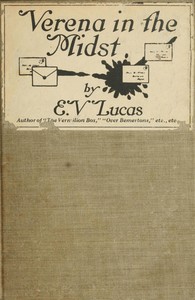
Verena in the Midst: A Kind of a Story — Inside the Classic
Historical Psychological Social Fiction
56,190 recorded words. 2 minutes difference from this book's estimate.
View Gutenberg source #63551
For The Loot of Cities Being the Adventures of a Millionaire in Search of Joy (a Fantasia); and Other Stories — A Closer Reading, the stored edition analysis reports 55,844 words, 4 hr 3 min estimated reading time, and 12 detected text sections.
The text analysis averages about 14.1 words per sentence, while the detected sections provide another way to judge how the source is divided.
Project Gutenberg metadata also associates the work with “England -- Social life and customs -- Fiction,” connecting these edition facts with the source record’s subject description.
Explore this collection
These alternatives are selected using recorded categories and estimated reading time.
About 245 minutes
Historical Psychological Social Fiction
56,190 recorded words. 2 minutes difference from this book's estimate.
View Gutenberg source #63551About 225 minutes
Historical Psychological Social Fiction
51,590 recorded words. 18 minutes difference from this book's estimate.
View Gutenberg source #63775About 217 minutes
Historical Psychological Social Fiction
49,772 recorded words. 26 minutes difference from this book's estimate.
View Gutenberg source #67089Search stored excerpts and compare books → Choose by your preferences →
Choices use stored catalog measurements. Estimates vary with reading speed. A shared category is a catalog label, not a claim that two books have the same argument or literary quality.
Search reads excerpt text stored with this catalog and links to its associated Gutenberg record. The connection is stored in the site database; this tool does not recheck that every excerpt is word-for-word identical to that external record. Excerpt search does not cover every chapter and does not verify historical publication dates.
Catalog snapshot checked: 2026-09-25. Coverage: 92 public books, 92 available source excerpts.
Calculated from edition completeness, EPUB availability, text structure and catalogue metadata. Not a user rating.
Total of 100 points, scaled to a 2.5-5.0 range. Editions with an empty description or a missing EPUB file are not scored.
Public-domain source text
The source text is kept in the dedicated reader, separate from this catalogue record and its commentary.
The title story, The Loot of Cities, opens not with a millionaire but with a managing director, Bruce Bowring, brushing his hair in his office at nearly seven on a Friday evening. The telephone rings with an anonymous warning of a robbery at his home—before nine o'clock. Bennett immediately establishes a world of electric-lit offices, Florentine mirrors, and Oriental carpets, where wealth is both displayed and threatened. The millionaire in search of joy, Cecil, appears later in the collection, but the catalog subject 'Millionaires—Fiction' is only one thread; the excerpts show Bennett more interested in the mechanics of money and the performance of class than in simple riches.
The anonymous telephone call in the first story is a striking structural device. The receiver whispers 'Nrrrr' and 'Cluck' before delivering its message—a detail that foregrounds the medium's strangeness. Bennett uses the telephone to inject mystery and urgency, but also to expose the fragility of Bowring's 'wondrously organised scheme.' The device recurs in other stories: in 'The Adventure of the Prima Donna,' a bet about obtaining opera tickets is set in motion by a newspaper advertisement, and the plot turns on a series of errands and telephone calls. Bennett treats communication technology as both a convenience and a source of anxiety, a theme that runs through several pieces.
The excerpt from 'The Adventure of the Prima Donna' shifts the setting to Paris, where the characters discuss a gala performance at the Opéra. The talk is of ticket prices, rival sopranos, and a scandalous agency at 155, Rue de la Paix. Bennett reproduces a newspaper article verbatim, embedding a satirical commentary on the traffic in social distinction. The bet between Cecil and Belmont—a two-hundred-dollar dinner at Paillard's—turns on the ability to obtain seats through money and nerve. Here, the 'loot of cities' is not cash but access, and the millionaire's joy seems to lie in winning a game of social one-upmanship.
Bennett gives minor characters memorable quirks. Lecky, Cecil's valet, 'squinted violently for a few seconds' before grasping his master's intention. His 'feeble French' is described as 'a delicate plant,' and he bows after giving up squinting. These details are not mere comic relief; they signal a world where servants must interpret their masters' whims with precision. In 'Mr. Penfound's Two Burglars' and 'The Police Station,' similar attention to the gestures and speech of clerks, waiters, and functionaries suggests that Bennett's real subject is the social ecosystem around wealth, not the millionaire alone.
Readers approaching Bennett's collection should attend to the interplay between the catalog subjects—'England—Social life and customs' and 'Short stories, English'—and the actual texture of the prose. The stories are less about millionaires than about the systems of money, status, and communication that surround them. Bennett's irony is dry, his details precise. The excerpts offer only fragments of each tale, but they reveal a writer more interested in the mechanics of a bet or the squint of a valet than in any grand adventure.
I finished The Loot of Cities feeling that odd ache for the things we chase, and how little they satisfy. That millionaire’s hunt, so empty despite all the glitter, stayed with me. It made me wonder about quieter paths, the ones not paved with gold. That’s what I find myself circling back to in Mr. Carteret and Others — Key Ideas to Explore, though I haven’t quite finished it yet.
Build a private reading journal entry for this title.