About 523 minutes
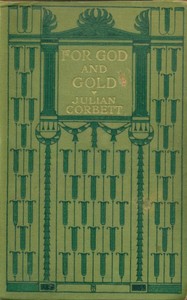
For God and Gold — Story, Setting & Ideas
Historical Psychological Social Fiction
120,230 recorded words. 25 minutes difference from this book's estimate.
View Gutenberg source #62184
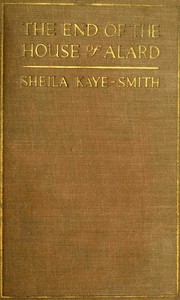
Before opening The end of the house of Alard — Inside the Classic, the edition data offers a quick orientation: 125,849 words, 9 hr 8 min estimated reading time, and 19 detected text sections.
The text analysis averages about 16.7 words per sentence, while the detected sections provide another way to judge how the source is divided.
Project Gutenberg metadata also associates the work with “Families -- England -- Fiction,” connecting these edition facts with the source record’s subject description.
Explore this collection
These alternatives are selected using recorded categories and estimated reading time.
About 523 minutes
Historical Psychological Social Fiction
120,230 recorded words. 25 minutes difference from this book's estimate.
View Gutenberg source #62184About 579 minutes
Historical Psychological Social Fiction
132,992 recorded words. 31 minutes difference from this book's estimate.
View Gutenberg source #65386About 515 minutes
Historical Psychological Social Fiction
118,259 recorded words. 33 minutes difference from this book's estimate.
View Gutenberg source #65799Search stored excerpts and compare books → Choose by your preferences →
Choices use stored catalog measurements. Estimates vary with reading speed. A shared category is a catalog label, not a claim that two books have the same argument or literary quality.
Search reads excerpt text stored with this catalog and links to its associated Gutenberg record. The connection is stored in the site database; this tool does not recheck that every excerpt is word-for-word identical to that external record. Excerpt search does not cover every chapter and does not verify historical publication dates.
Catalog snapshot checked: 2026-09-25. Coverage: 92 public books, 92 available source excerpts.
Calculated from edition completeness, EPUB availability, text structure and catalogue metadata. Not a user rating.
Total of 100 points, scaled to a 2.5-5.0 range. Editions with an empty description or a missing EPUB file are not scored.
Public-domain source text
The source text is kept in the dedicated reader, separate from this catalogue record and its commentary.
The novel begins not with a character but with a chronicle: the Alards are introduced through their tombs in Winchelsea church, their Crusader ancestor, and their gradual decline from maritime power to landed gentry. The first Gervase Alard, Admiral of the Cinque Ports, lies cross-legged; later Alards married into the Oxenbridges, and a branch settled at Conster Manor, rebuilt in Elizabeth's day. This opening establishes a layered sense of history—stone, heraldry, and the marsh landscape—that frames the family's present struggles.
When the narrative shifts to Jenny Alard, she is visiting Fourhouses Farm with her brother Peter. The farm's owner, Godfrey, is a yeoman farmer whose stock and solidity contrast with the Alards' crumbling estate. Jenny's immediate attraction to Godfrey is entangled with her perception of the farm as a refuge from her family's decay. The excerpts show her grappling with a choice between love and loyalty, while Peter voices the Squire's burden: 'We can't shelve our responsibilities.'
The opening pages read like a manorial roll: names, dates, heraldic blazons, and land transactions. Kaye-Smith lists ships—St. Peter, Nostre Dame, La Nave Dieu—and records that William Alard lost thirty sailors in Gascony. This is not mere background; it establishes a family whose identity is inseparable from its feudal past. The prose itself is measured, almost genealogical, until the narrative narrows to Conster Manor, 'a stone house with three hipped gables and a huge red sprawl of roof.'
The effect is to make the reader aware that every present action carries the weight of centuries. When Peter later speaks of 'a tradition as old as theirs,' the opening has already given that tradition texture. The Alards are not simply a family; they are a historical artifact, and their end is felt as the close of a long chronicle.
Jenny Alard's perspective dominates the middle excerpts. At Fourhouses, she is struck by Godfrey's look—'her heart was violently turned to the man from his surroundings.' The farm's 'beauties and uglinesses' become dim; she sees only the man she must love. Yet her attraction is complicated by class consciousness. She reflects that the Godfreys' life is 'sound in fundamentals,' built on rock, while Alard is 'the house built on the sand, the sand of a crumbled and obsolete tradition.'
This metaphor recurs: the Alard house is both literal estate and symbolic structure. Jenny's internal debate is not merely romantic but existential. She envies the Godfreys' freedom from 'keeping up appearances,' yet Peter's appeal to duty checks her. The excerpts leave her decision unresolved, but the tension between personal desire and familial obligation is sharply drawn.
Peter Alard, Jenny's brother, speaks for the old order. Walking back from Fourhouses, he praises the yeoman farmer but insists that the Alards cannot 'shelve our responsibilities.' He acknowledges that the Godfreys may be happier, but argues that 'we can't ever be like them.' His language is pragmatic—he discusses taxation, labour costs, and the shift to livestock—but his core belief is in class duty.
Peter's voice is not nostalgic; it is anxious. He notes that 'Government supports' the farmer but 'won't do a thing for us.' The Squire is being squeezed by modernity. Yet he remains proud: 'Personally I'm proud of it.' This pride, however, is a burden. The excerpts suggest that Peter's commitment to tradition may be as much a trap as a virtue, and that the 'end of the house of Alard' is not merely economic but psychological.
The Sussex landscape is more than setting; it is a force that shapes the characters' lives. Conster Manor looks 'down into the valley of the river Tillingham,' with farms named Doucegrove, Glasseye, and Starvecrow standing 'against the woods beyond.' The marsh, the river, the hoke above Bukenie—these are not decorative details but markers of a world where land is identity.
Jenny's perception of Fourhouses merges the farm's physical details with her emotional turmoil: 'the outhouses and stables, tools and stock, were only a part of this bewildered turning of herself.' The land becomes an extension of her inner state. Similarly, Peter's discussion of drainage and cattle breeding is not mere agricultural talk; it is a measure of viability. The novel's title, The End of the House of Alard, is as much about the land as about the family—the house is rooted in the soil, and its end is a change in the landscape itself.
The excerpts offer a focused entry into the novel's central conflict: the collision between inherited duty and personal desire, set against a vividly realized Sussex landscape. Readers attentive to the opening's historical density will find that every later scene—Jenny's attraction to Godfrey, Peter's defense of class, the farm's solidity—echoes the weight of ancestry. The novel does not resolve these tensions quickly; instead, it invites the reader to watch a family's slow dissolution, one conversation, one glance, one acre at a time.
There’s something about watching a family lose its footing that stays with you, isn’t there? The Alards made me think of that feeling, how the ground shifts under old certainties. It reminded me, quietly, of another story about fortunes tied to what feels unshakable—this one: Caleb Conover, Railroader — Background and Themes. I keep turning it over, the way such tales linger long after the last page.
Answer a few questions and save a private reflection on this device.