About 61 minutes
"The Liberry" — Inside the Classic
Historical Psychological Social Fiction
13,928 recorded words. 14 minutes difference from this book's estimate.
View Gutenberg source #66454
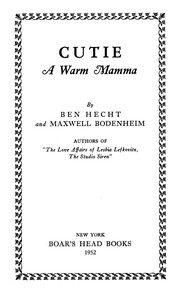
This digital edition of Cutie: A Warm Mamma — Text and Context is described by source-level measurements including 10,805 words, 47 min estimated reading time, and 12 detected text sections.
The text analysis averages about 16.2 words per sentence, while the detected sections provide another way to judge how the source is divided.
Project Gutenberg metadata also associates the work with “Satire,” connecting these edition facts with the source record’s subject description.
Explore this collection
These alternatives are selected using recorded categories and estimated reading time.
About 61 minutes
Historical Psychological Social Fiction
13,928 recorded words. 14 minutes difference from this book's estimate.
View Gutenberg source #66454About 27 minutes
Historical Psychological Social Fiction
6,180 recorded words. 20 minutes difference from this book's estimate.
View Gutenberg source #63107About 27 minutes
Historical Psychological Social Fiction
6,079 recorded words. 20 minutes difference from this book's estimate.
View Gutenberg source #66828Search stored excerpts and compare books → Choose by your preferences →
Choices use stored catalog measurements. Estimates vary with reading speed. A shared category is a catalog label, not a claim that two books have the same argument or literary quality.
Search reads excerpt text stored with this catalog and links to its associated Gutenberg record. The connection is stored in the site database; this tool does not recheck that every excerpt is word-for-word identical to that external record. Excerpt search does not cover every chapter and does not verify historical publication dates.
Catalog snapshot checked: 2026-09-25. Coverage: 92 public books, 92 available source excerpts.
Calculated from edition completeness, EPUB availability, text structure and catalogue metadata. Not a user rating.
Total of 100 points, scaled to a 2.5-5.0 range. Editions with an empty description or a missing EPUB file are not scored.
Public-domain source text
The source text is kept in the dedicated reader, separate from this catalogue record and its commentary.
The preface by Maxwell Bodenheim frames Cutie: A Warm Mamma as a direct satire on “ultra-prudish hypocritical censors and assailers of sexual candor.” Originally serialized in the Chicago Literary Times in 1924, the work targets both official and amateur crusaders for “cleanliness and righteousness.” The authors’ stated method is to treat the censor’s fig leaf as “ludicrously transparent,” directing attention to what it hides. This editorial stance is crucial: the book is not a general social comedy but a pointed, period-specific attack on suppression of artistic expression.
The excerpts center on Herman Pupick, a “celebrated censor and reformer” whose physical and moral indignities drive the humor. Upon waking in lavender pajamas, he is described as “a cross between a chop suey pedlar and the inside of an Odd Fellow’s coffin.” His zeal is deflated by Cutie’s deadpan mockery: she calls him “poison ivy” and threatens to “play taps on your skull with this crowbar.” The satire operates through bodily comedy—Herman sinks his “false teeth into her ankle”—rather than argument. The catalog subject “Satire” is borne out, but the excerpts show a farce that relies on slapstick and verbal deflation, not subtle irony.
Cutie speaks in a vernacular that mixes theatrical slang and blunt dismissal: “My Gawd, he’s gone cuckoo again.” Her entrance is described as “a little overdressed for a Ziegfield chorus, but nobody in their right mind would have barred her out of a school for the blind.” The excerpts present her as a pragmatic foil to Herman’s ranting, but they do not reveal her backstory or motives. The catalog subject “Man-woman relationships” is present only in the farcical power struggle—Herman declares Cutie his “inspiration” while she threatens him with a crowbar. Readers should note that the excerpts offer no romantic development; the relationship remains a comic standoff.
A key scene has Herman, wounded, spotting on a table “all the books he had suppressed in the last ten years.” He tears them to shreds, leaving the room “as if a nanny goat had been sleeping in it.” The catalog subject “Reformers” is thus literalized: Herman’s reform is a destructive, almost animalistic impulse. The preface’s claim that censors “fashion would-be ugly effigies” is dramatized here. Yet the excerpts do not name any specific suppressed works or real-world targets, so the satire remains generalized. The humor depends on recognizing the type—the self-righteous censor—rather than specific historical referents.
The excerpts reveal a work that is more physical farce than intellectual debate, despite the preface’s theoretical framing. Readers expecting a sustained argument about censorship will find instead a series of comic set-pieces built on Herman’s humiliation and Cutie’s irreverence. The brevity of the text (about 10,800 words) and its serial origins suggest a quick, episodic read. Approach it as a period satire that uses broad comedy to needle a specific target: the official and unofficial enforcers of literary propriety in 1920s America.
That old Cutie satire stayed with me—not for the jokes, but for how gently it ached around all that noise, all that pretending. It made me think of the quieter sorrow in The Great Accident — Themes and Context, where lives just miss each other. Both left me sitting still, feeling the weight of what we don’t say out loud.
Build a private reading journal entry for this title.