About 314 minutes
The Driver — Inside the Classic
Fantasy Juvenile Worlds
72,217 recorded words. 7 minutes difference from this book's estimate.
View Gutenberg source #65853
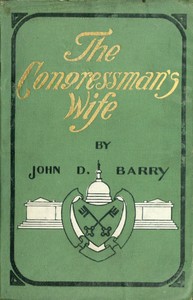
The source record for The congressman's wife, a story of American politics — Reading Companion measures this digital text at 70,436 words, 5 hr 7 min estimated reading time, and 32 detected text sections.
The text analysis averages about 11.3 words per sentence, while the detected sections provide another way to judge how the source is divided.
Project Gutenberg metadata also associates the work with “Political fiction,” connecting these edition facts with the source record’s subject description.
Explore this collection
These alternatives are selected using recorded categories and estimated reading time.
About 314 minutes
Fantasy Juvenile Worlds
72,217 recorded words. 7 minutes difference from this book's estimate.
View Gutenberg source #65853About 327 minutes
Fantasy Juvenile Worlds
75,006 recorded words. 20 minutes difference from this book's estimate.
View Gutenberg source #66622About 330 minutes
Fantasy Juvenile Worlds
75,836 recorded words. 23 minutes difference from this book's estimate.
View Gutenberg source #68692Search stored excerpts and compare books → Choose by your preferences →
Choices use stored catalog measurements. Estimates vary with reading speed. A shared category is a catalog label, not a claim that two books have the same argument or literary quality.
Search reads excerpt text stored with this catalog and links to its associated Gutenberg record. The connection is stored in the site database; this tool does not recheck that every excerpt is word-for-word identical to that external record. Excerpt search does not cover every chapter and does not verify historical publication dates.
Catalog snapshot checked: 2026-09-25. Coverage: 92 public books, 92 available source excerpts.
Calculated from edition completeness, EPUB availability, text structure and catalogue metadata. Not a user rating.
Total of 100 points, scaled to a 2.5-5.0 range. Editions with an empty description or a missing EPUB file are not scored.
Public-domain source text
The source text is kept in the dedicated reader, separate from this catalogue record and its commentary.
The novel opens with a white-haired Senator and Douglas Briggs exchanging pleasantries about Washington in spring, a scene that immediately establishes the social rhythms of political life. The Senator's remark that 'the women bear it better than the men' hints at the gendered pressures to come. Briggs's wife Helen is mentioned as 'rather run down' from entertaining, a detail that foreshadows the domestic cost of public ambition.
Barry's preface clarifies his intent: not to depict political conditions per se, but to trace 'purely social and human complications' arising from the contrast between public and private standards. This framing prepares readers for a story centered on personal dilemmas rather than legislative mechanics.
The first chapter's dialogue between the Senator and Briggs is deceptively casual. The Senator's nostalgic remark about a simpler Washington 'more than a quarter of a century ago' contrasts with the present social grind, which he blames for killing a colleague ('too many dinners'). Briggs's quick addition—'if they keep us here'—introduces anxiety about political tenure. The exchange is laden with unspoken pressures: the need to send families away from the heat, the strain on wives, the fatal toll of entertaining. Barry uses this polite conversation to map the social ecosystem that will drive the plot.
Notice how the Senator's 'delicate moisture' on his face and his benign gaze from the Capitol steps establish him as a seasoned observer, while Briggs's nods and quick interjections suggest a man managing appearances. The setting—the Capitol in spring—is both idyllic and ironic, as the beauty of the season masks the corrosive demands of political life.
Later excerpts shift from public performance to private dread. Briggs lies awake in 'the middle of the night,' a 'cold perspiration' on his forehead, tormented by financial ruin and the fear of failing his family. Barry renders this anxiety with physical precision: the 'vague consciousness of profound misery' that strikes in early morning, the feeling of being 'a helpless prisoner' in bed. These passages reveal a man who, by day, maintains 'artificial gayety' for his son Guy, but by night confronts his own recklessness.
The text specifies that Briggs 'began to plunge' into speculation, justifying it as 'desperate remedies' to rid himself of a political rival, Franklin West. His self-accusation—'he had accomplished nothing'—and the sense of being 'prematurely old' at forty-two ground his crisis in concrete middle-class fears. The broker Balcombe, described as 'small, keen-eyed, sandy,' becomes a recurring figure whose visits signal mounting danger.
Briggs's entanglement with Balcombe illustrates the novel's central tension between public integrity and private compromise. Guy, the son, knows Balcombe only as a club frequenter, unaware that his father's speculations have escalated. Barry shows Briggs oscillating between elation and depression: on good days he orders 'something especially good to eat'; on bad days he 'could not discipline himself into good humor.' The broker's presence at the door, which Guy is told to keep closed, literalizes the secrecy corroding the household.
The narrative voice notes that Briggs 'tried to excuse himself for his recklessness on the plea of desperate remedies,' a phrase that captures his self-deception. The excerpts do not reveal whether Briggs succumbs to the 'dozen easy ways' out of debt that tempt him—men who would take his notes without explicit promises. This ambiguity is deliberate, leaving readers to track how far he will go.
Though Helen Briggs appears only indirectly in the excerpts—as 'run down,' as the object of her husband's 'whole solicitude'—her absence is a structuring force. The preface explicitly frames the story around 'the contrast between the standards a man may follow in public life ... and those he maintains at home, with his wife and children.' The opening dialogue's concern for 'the little ones' and the wife's health signals that domestic welfare is the stakes of Briggs's gamble.
Barry's choice to keep Helen offstage in these early sections creates a vacuum that the reader fills with anticipation. When Briggs worries about his life insurance policy becoming 'a burden,' the reader senses that Helen's security is precarious. The novel's title, The Congressman's Wife, promises that her perspective will eventually emerge, but the excerpts leave her interiority unexplored—a gap that invites attention to how she is spoken about versus how she might speak.
Barry's novel rewards attention to its small, telling details: the Senator's 'delicate moisture,' the broker's sandy hair, the son's ignorance of his father's deals. The excerpts offer a portrait of a man caught between public performance and private dread, with his wife's well-being as the unspoken measure of his choices. Readers may find it useful to track how the social rituals of Washington—dinners, club meetings, casual conversations—mask or reveal the moral costs that the preface promises to explore.
The rain kept tapping the window while I sat with The Congressman’s Wife, tracing how ambition quietly hollows out a marriage. That sleepless anxiety lingered after I closed it. Later, half-dreaming, I reached for something lighter on the shelf—Bob Bowen Comes to Town — Inside the Classic—and found the same frayed edges of public pretense, only gentler.
Answer a few questions and save a private reflection on this device.