About 330 minutes
The eagle's wing: A story of the Colorado — Background and Themes
Fantasy Juvenile Worlds
75,836 recorded words. 26 minutes difference from this book's estimate.
View Gutenberg source #68692
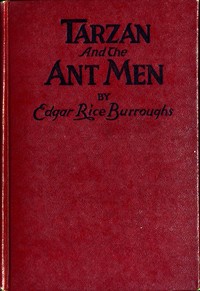
This digital edition of Tarzan and the Ant Men — Themes and Context is described by source-level measurements including 81,780 words, 5 hr 56 min estimated reading time, and 8 detected text sections.
The text analysis averages about 21.1 words per sentence, while the detected sections provide another way to judge how the source is divided.
Project Gutenberg metadata also associates the work with “Tarzan (Fictitious character) -- Fiction,” connecting these edition facts with the source record’s subject description.
Explore this collection
These alternatives are selected using recorded categories and estimated reading time.
About 330 minutes
Fantasy Juvenile Worlds
75,836 recorded words. 26 minutes difference from this book's estimate.
View Gutenberg source #68692About 383 minutes
Fantasy Juvenile Worlds
87,976 recorded words. 27 minutes difference from this book's estimate.
View Gutenberg source #68725About 327 minutes
Fantasy Juvenile Worlds
75,006 recorded words. 29 minutes difference from this book's estimate.
View Gutenberg source #66622Search stored excerpts and compare books → Choose by your preferences →
Choices use stored catalog measurements. Estimates vary with reading speed. A shared category is a catalog label, not a claim that two books have the same argument or literary quality.
Search reads excerpt text stored with this catalog and links to its associated Gutenberg record. The connection is stored in the site database; this tool does not recheck that every excerpt is word-for-word identical to that external record. Excerpt search does not cover every chapter and does not verify historical publication dates.
Catalog snapshot checked: 2026-09-25. Coverage: 92 public books, 92 available source excerpts.
Calculated from edition completeness, EPUB availability, text structure and catalogue metadata. Not a user rating.
Total of 100 points, scaled to a 2.5-5.0 range. Editions with an empty description or a missing EPUB file are not scored.
Public-domain source text
The source text is kept in the dedicated reader, separate from this catalogue record and its commentary.
The novel opens not with Tarzan but with Esteban Miranda, a Spaniard who has so thoroughly impersonated the ape-man that he now believes himself to be Tarzan. Chained in a cannibal village, he gnaws a half-cooked fish while the chief Obebe and the witch doctor argue over his fate—one wanting to eat him, the other fearing he is a river devil. This initial scene establishes a pattern of mistaken identity and layered deception that runs through the book. Burroughs uses direct, declarative sentences and a matter-of-fact tone even for absurd situations, such as a slave who has never seen the surface world.
The narrative voice in the first chapter is notably detached, describing Esteban Miranda's predicament with clinical precision: “In the filth of a dark hut… Esteban Miranda squatted upon his haunches and gnawed upon the remnants of a half-cooked fish.” The prose avoids emotional commentary, letting the squalor speak for itself. Miranda’s delusion is presented as a matter of fact: “he had come not only to act the part, but to live it—to be it.” This flat statement contrasts with the absurdity of a man believing he is someone else while chained like a dog. The witch doctor’s counter-claim—that Miranda is a river devil—adds another layer of mistaken identity, turning the prisoner into a pawn in a superstitious power struggle. Burroughs uses short, punchy sentences to convey the stalemate: “If Esteban died a natural death he was Tarzan… if he lived on forever… the claim of the witch doctor would be accepted as gospel.” The irony is that neither side is correct, but the narrative never winks at the reader.
When Tarzan reaches the Minunian underground city, the diction shifts to emphasize a bureaucratic, numbered existence. Slaves are identified by numbers like “Eight Hundred Cubed, Plus Nineteen” and “Eight Hundred Cubed, Plus Twenty-one.” This numerical naming strips individuality, yet the dialogue reveals personal bonds forming despite the system. The slave who says “while he remains a slave he has no name, but will go always by his number” accepts the dehumanization, while Tarzan (as Zuanthrol) resists by giving a name. The girl Talaskar explains she was “born in this chamber” and has never been to the surface—a detail that underscores the total control of the slave society. Burroughs uses the contrast between the cold numbers and the warmth of Talaskar’s offer to cook for Tarzan to highlight the persistence of human connection. The phrase “I will cook for you, too. I cook for him” is simple but loaded with meaning in a world where even kindness is rationed.
Throughout the excerpts, physical appearance is a form of communication and deception. Talaskar demonstrates this when she transforms her face: “For just an instant she turned her back upon him, putting her hands to her face and to her hair, and then she faced him again and the ape-man saw before him a hideous and wrinkled hag.” The act is performed without explanation, showing that disguise is a survival skill in this world. Tarzan himself is mistaken for a Zertalacolol—a giant—because of his size, and he plays along: “I am a Zertalacolol to my masters.” The hieroglyphics fastened on his shoulder are another text: they mark him as property, but he subverts their meaning by adopting the name Zuanthrol. Burroughs’ description of Talaskar’s beauty—“pale, translucent skin… blue-black of a wealth of lustrous hair”—is deliberately poetic, contrasting with the grim setting. The quick shift from beauty to hag underscores the theme that identity is performative and precarious.
Burroughs structures the narrative around physical and psychological confinement. Esteban Miranda is literally chained; the Minunian slaves are bound by numbers and walls. Yet within these constraints, small acts of defiance occur. The slave who warns Tarzan, “I shall not be the one to betray you,” shows solidarity. Talaskar’s mother hid her birth to prevent forced mating, a quiet rebellion against the system. The dialogue is often terse, with characters speaking in short, functional sentences that reflect their limited agency. When Tarzan says “Do not lose hope,” the line feels almost out of place in this grim world, yet it signals his role as a catalyst for change. The narrative does not explain how escape might happen; it simply records these moments of connection. The recurring motif of food—from the half-cooked fish to the grilled cut of flesh—grounds the story in bodily needs, reminding readers that captivity is as much about hunger as it is about freedom.
Burroughs’ prose in Tarzan and the Ant Men is lean and functional, yet it carries a surprising weight of implication. The author does not moralize about slavery or identity; instead, he lets the stark details—the iron collar, the numbered tunics, the quick-change disguise—speak for themselves. Readers attentive to the dialogue will notice how characters reveal their circumstances through what they say and what they leave unsaid. The novel rewards a focus on the small, concrete choices in language and description, which together build a world where nothing is quite as it seems.
I finished Tarzan and the Ant Men and kept thinking about how easily people mistake who they really are—how a costume or a name can blur everything. That same unease followed me in In colonial days — Context and Discussion, where identity shifts like shadows at dusk. It’s strange how old stories still whisper the same quiet truths.
A brief reflection can help important ideas stay with you longer.