About 265 minutes
The Man Inside — Context and Discussion
Science Fiction Utopias
60,769 recorded words. 13 minutes difference from this book's estimate.
View Gutenberg source #63223
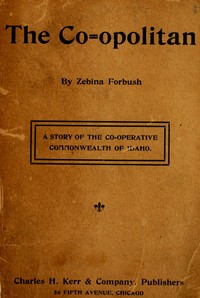
This digital edition of The Co-opolitan: A Story of the Co-operative Commonwealth of Idaho — Background and Themes is described by source-level measurements including 63,724 words, 4 hr 38 min estimated reading time, and 35 detected text sections.
The text analysis averages about 22.0 words per sentence, while the detected sections provide another way to judge how the source is divided.
Project Gutenberg metadata also associates the work with “Utopias -- Fiction,” connecting these edition facts with the source record’s subject description.
Explore this collection
These alternatives are selected using recorded categories and estimated reading time.
About 265 minutes
Science Fiction Utopias
60,769 recorded words. 13 minutes difference from this book's estimate.
View Gutenberg source #63223About 236 minutes
Science Fiction Utopias
54,084 recorded words. 42 minutes difference from this book's estimate.
View Gutenberg source #68789About 209 minutes
Science Fiction Utopias
48,038 recorded words. 69 minutes difference from this book's estimate.
View Gutenberg source #62637Search stored excerpts and compare books → Choose by your preferences →
Choices use stored catalog measurements. Estimates vary with reading speed. A shared category is a catalog label, not a claim that two books have the same argument or literary quality.
Search reads excerpt text stored with this catalog and links to its associated Gutenberg record. The connection is stored in the site database; this tool does not recheck that every excerpt is word-for-word identical to that external record. Excerpt search does not cover every chapter and does not verify historical publication dates.
Catalog snapshot checked: 2026-09-25. Coverage: 92 public books, 92 available source excerpts.
Calculated from edition completeness, EPUB availability, text structure and catalogue metadata. Not a user rating.
Total of 100 points, scaled to a 2.5-5.0 range. Editions with an empty description or a missing EPUB file are not scored.
Public-domain source text
The source text is kept in the dedicated reader, separate from this catalogue record and its commentary.
Zebina Forbush’s The Co-opolitan (1898) is less a novel of character than a legislative blueprint cast as fiction. The preface immediately establishes the author’s rhetorical stance: reform must come through education, not revolution, and must win over “the substantial business interests.” The narrative that follows is accordingly dense with tax codes, property laws, and labor regulations, all presented as the workings of a Great Council. Forbush’s prose is declarative and legalistic, favoring exposition over scene-setting. Dialogue is sparse; when it appears, it serves to explain policy rather than reveal personality. The result is a work that reads like a policy brief with a thin fictional frame—a deliberate choice that prioritizes argument over artistry.
Forbush opens not with a story but with an essay. He declares that “no radical and permanent reform can be successfully effected without the consent of what are called ‘the substantial business interests’ of the established system.” This sentence reveals his core assumption: change must be evolutionary, not revolutionary. He dismisses “political Co-operation” as doomed because “the Industrial System is against it.” The preface’s tone is weary and pragmatic, contrasting with the utopian content that follows. Forbush’s diction—words like “Mephisto,” “will-o’-the-wisp,” and “millions in the competitive system”—frames capitalism as a seductive, almost supernatural opponent. This rhetorical choice sets the novel’s argumentative, rather than narrative, trajectory.
The excerpt detailing the single-tax system on land values is the novel’s most extended piece of policy exposition. Forbush describes how cattle men were taxed collectively on the total acreage of their range, with each owner responsible for ensuring neighbors paid their share. The language is precise: “the value of the range per acre was estimated upon the basis of its use for grazing purposes.” The narrative then recounts legal and armed resistance, with the Great Council—composed entirely of Co-operators—reversing a lower court decision. The press is portrayed as hostile, siding with the cattle men. Forbush’s authorial voice here is that of a legal historian, not a novelist; he is more interested in the mechanics of enforcement than in dramatizing conflict.
Forbush addresses labor competition directly. When mine owners attempt to import Chinese, Italian, Hungarian, and Slavonian workers, the Great Council responds with laws prohibiting aliens from owning real estate or being employed within the state. The Supreme Court later upholds these laws. Forbush’s language is notably blunt: “We offered no encouragement to dishonest practices.” The passage reveals an exclusionary strain in the cooperative vision—one that protects existing workers by barring outsiders. The author does not question this policy; he presents it as a natural defense against “cheaper labor.” This detail complicates the utopian label, showing that Forbush’s commonwealth is built on selective membership, not universal brotherhood.
Throughout the excerpts, Forbush returns to a central binary: righteousness versus money. In the preface, he writes that “Righteousness without money is a will-o’-the-wisp as against Mephisto, with millions in the competitive system.” This metaphor recurs implicitly in the later passages, where the cooperative commonwealth’s moral authority is contrasted with the “immoral” press and the “honest” cattle men who flee taxes. Forbush’s authorial stance is defensive; he repeatedly anticipates criticism and rebuts it. The novel’s structure is thus argumentative, with each policy described as a response to an objection. This rhetorical pattern—assertion, challenge, refutation—gives the prose a legalistic rhythm, more akin to a brief than a narrative.
Readers should approach The Co-opolitan as a work of political advocacy dressed in fiction. Forbush’s choices—the expository preface, the policy-heavy dialogue, the absence of individual character arcs—all serve his didactic purpose. The novel is best understood not as a story but as a thought experiment: what would a cooperative commonwealth look like if built through legal and economic mechanisms? The answer, Forbush suggests, is a state that taxes land values, excludes alien labor, and operates mines directly. Whether one finds this vision inspiring or troubling, the book’s value lies in its detailed articulation of a specific reform program.
That rainy afternoon, The Co-opolitan felt less like a blueprint than a quiet prayer for fairness. I kept circling back to its faith in gradual change, education over upheaval. Later, reaching for something lighter, I found myself tucked into The Plymouth Express Affair — Context and Discussion, and realized both books share a patient eye for small turns that remake a whole world.
Save your reaction, strongest insight, and memorable passage.