About 424 minutes
After the Manner of Men — Text and Context
Science Fiction Utopias
97,294 recorded words. 9 minutes difference from this book's estimate.
View Gutenberg source #66631
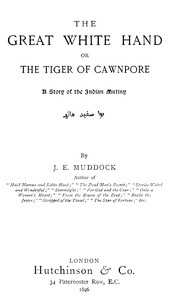
For The Great White Hand; Or, the Tiger of Cawnpore: A story of the Indian Mutiny — Text and Context, the stored edition analysis reports 99,362 words, 7 hr 13 min estimated reading time, and 10 detected text sections.
The text analysis averages about 16.6 words per sentence, while the detected sections provide another way to judge how the source is divided.
Project Gutenberg metadata also associates the work with “India -- History -- Sepoy Rebellion, 1857-1858 -- Fiction,” connecting these edition facts with the source record’s subject description.
Explore this collection
These alternatives are selected using recorded categories and estimated reading time.
About 424 minutes
Science Fiction Utopias
97,294 recorded words. 9 minutes difference from this book's estimate.
View Gutenberg source #66631About 403 minutes
Science Fiction Utopias
92,476 recorded words. 30 minutes difference from this book's estimate.
View Gutenberg source #65837About 476 minutes
Science Fiction Utopias
109,428 recorded words. 43 minutes difference from this book's estimate.
View Gutenberg source #68237Search stored excerpts and compare books → Choose by your preferences →
Choices use stored catalog measurements. Estimates vary with reading speed. A shared category is a catalog label, not a claim that two books have the same argument or literary quality.
Search reads excerpt text stored with this catalog and links to its associated Gutenberg record. The connection is stored in the site database; this tool does not recheck that every excerpt is word-for-word identical to that external record. Excerpt search does not cover every chapter and does not verify historical publication dates.
Catalog snapshot checked: 2026-09-25. Coverage: 92 public books, 92 available source excerpts.
Calculated from edition completeness, EPUB availability, text structure and catalogue metadata. Not a user rating.
Total of 100 points, scaled to a 2.5-5.0 range. Editions with an empty description or a missing EPUB file are not scored.
Public-domain source text
The source text is kept in the dedicated reader, separate from this catalogue record and its commentary.
Muddock's prose in The Great White Hand relies on sharp sensory cues—the "click, click" of a rifle, the gush of "warm blood" over a hand—to build tension in moments of crisis. The author, who states in his preface that he was "in India during the terrible time of the Sepoy Rebellion," writes with a journalist's eye for concrete detail, though the excerpts offer only a narrow window into the full narrative.
The novel's dialogue and description work in tandem: Haidee's prayer to "ye Houris of goodness" and her frantic kisses contrast with Harper's terse, soldierly warnings. This blend of melodrama and reportage suggests a work that oscillates between sentimental romance and historical thriller, though the complete arc of the story remains unclear from the available text.
Muddock's word choices in the excerpted passage are deliberately visceral. He describes a bullet finding "its billet," a phrase that merges military precision with fatal inevitability. The repetition of "report" and "tongue of fire" for gunshots emphasizes the suddenness of violence. Haidee's speech shifts between colloquial English—"Oh, my beloved!"—and a more formal, almost liturgical register: "Oh, ye Houris of goodness!" This code-switching marks her as a character caught between cultures, though the excerpts do not reveal her background fully.
The author also uses physical details to convey emotional states. Harper's arm around Haidee is described as "passing his arm round her," a gesture that recurs, reinforcing protection and intimacy. The blood that "gushed out" and "flowed over her hand and arm" is not merely a plot point but a tactile image meant to make the reader feel the warmth and stickiness of the wound. Such diction prioritizes immediate sensation over abstract reflection.
Haidee's voice dominates the rescue scene, yet her actions are framed through a Victorian lens of feminine devotion. She prays, she kisses, she stanches the wound—but her physical strength is described as borrowed: "Oh, that I had a man's strength but for a brief half-hour." The narrator then undercuts this with the rhetorical question "what will love not do?" suggesting that her heroism is an exception, not a norm.
Harper, by contrast, speaks in clipped, imperative sentences: "Crouch down, Haidee. Crouch down." His soldier's ear detects the rifle's click before the shot, and his final action is to place himself before her. The dialogue thus establishes a gendered division of labor—he protects, she nurtures—even as the plot forces Haidee into a physically demanding role. Whether this pattern holds throughout the novel cannot be determined from the excerpts alone.
The excerpted passage builds suspense through a careful sequence of pauses and accelerations. Harper and Haidee move in silence, then stop; Harper whispers, then points; they proceed, then stop again at the sound of the rifle. Each halt increases the reader's anticipation. The setting—"clustering trees," "straggling native huts," a "small mound" with palms—is sketched with just enough detail to create a sense of place without slowing the pace.
Muddock also uses paragraph breaks to control tempo. Short paragraphs like "It was quite dark now; even the stars were obscured" isolate moments of stillness, while longer paragraphs accumulate action. The final paragraph, describing Haidee's struggle to carry Harper, strings together clauses with commas and semicolons, mimicking her breathless effort. This structural choice reinforces the theme of endurance against overwhelming odds.
Two details recur in the excerpt with potential symbolic weight: darkness and the act of listening. The night is "quite dark," stars obscured, and characters rely on sound—the click of a rifle, a gurgling gasp—to navigate danger. This sensory deprivation heightens the threat of ambush and may reflect a broader pattern in the novel of characters operating in moral or physical obscurity.
Haidee's prayer to "Houris" (celestial maidens in Islamic tradition) and her reference to "the gates of Paradise" introduce a religious vocabulary that is not explained in the excerpt. The author's dedication to his father, who died in Calcutta in 1861, frames the novel as a personal memorial. Whether these elements coalesce into a coherent thematic argument about faith, empire, or memory is impossible to judge from the available text, but they suggest layers beyond the adventure plot.
Readers approaching The Great White Hand should attend to how Muddock balances historical detail with melodramatic convention. The excerpts reveal a writer who trusts sensory immediacy—the sound of a rifle, the feel of blood—to carry emotional weight, but who also leans on Victorian tropes of feminine sacrifice and masculine protection. The preface's claim of personal experience invites scrutiny: does the novel's authority rest on memory or imagination? The answer likely lies in the full text's treatment of the mutiny's chaos and its characters' fates.
Reading of Haidee’s desperate strength brought back my grandmother’s hands gripping the kitchen counter the night she told me about fleeing Lahore—that same quiet ferocity hidden beneath calm. I remembered then how The Poet — Key Ideas to Explore had lingered with me for its way of honoring unspoken endurance. Both books felt like holding a breath for someone else’s courage.
Save your reaction, strongest insight, and memorable passage.