About 186 minutes
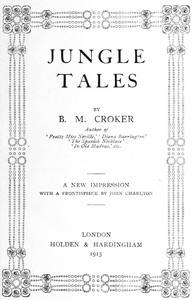
Jungle Tales — A Reader’s Guide
Science Fiction Utopias
42,770 recorded words. 10 minutes difference from this book's estimate.
View Gutenberg source #65561
The catalog record for A Warning to the Curious, and Other Ghost Stories — A Reader’s Guide provides practical reading context through 40,302 words, 2 hr 56 min estimated reading time, and 12 detected text sections.
The text analysis averages about 21.6 words per sentence, while the detected sections provide another way to judge how the source is divided.
Project Gutenberg metadata also associates the work with “Short stories, English,” connecting these edition facts with the source record’s subject description.
Explore this collection
These alternatives are selected using recorded categories and estimated reading time.
About 186 minutes
Science Fiction Utopias
42,770 recorded words. 10 minutes difference from this book's estimate.
View Gutenberg source #65561About 145 minutes
Science Fiction Utopias
33,346 recorded words. 31 minutes difference from this book's estimate.
View Gutenberg source #62821About 207 minutes
Science Fiction Utopias
47,396 recorded words. 31 minutes difference from this book's estimate.
View Gutenberg source #68754Search stored excerpts and compare books → Choose by your preferences →
Choices use stored catalog measurements. Estimates vary with reading speed. A shared category is a catalog label, not a claim that two books have the same argument or literary quality.
Search reads excerpt text stored with this catalog and links to its associated Gutenberg record. The connection is stored in the site database; this tool does not recheck that every excerpt is word-for-word identical to that external record. Excerpt search does not cover every chapter and does not verify historical publication dates.
Catalog snapshot checked: 2026-09-25. Coverage: 92 public books, 92 available source excerpts.
Calculated from edition completeness, EPUB availability, text structure and catalogue metadata. Not a user rating.
Total of 100 points, scaled to a 2.5-5.0 range. Editions with an empty description or a missing EPUB file are not scored.
Public-domain source text
The source text is kept in the dedicated reader, separate from this catalogue record and its commentary.
M. R. James opens 'The Haunted Doll's House' with a dealer and a collector circling each other in a shop, their dialogue a careful dance of bluff and appraisal. The narrator notes that Mr Dillet 'lied in his throat, and knew that he lied' when he feigned indifference to a miniature cabinet. This early detail signals James's method: the supernatural emerges not from gothic excess but from the social rituals and professional jargon of antiquarians. The story's title, placed in the contents list among 'The Uncommon Prayer-Book' and 'A Neighbour's Landmark,' announces a world where domestic objects and legal documents become conduits for horror.
James's protagonists are typically scholars or clergymen who pride themselves on rational inquiry. In 'A View from a Hill,' Fanshawe examines archaeological transactions and finds the writing 'odd, pompous, only half-educated.' He speculates that the author, Mr Baxter, 'would have been a very distinguished antiquary' with more schooling—but then qualifies this with a list of flaws: 'a certain love of opposition and controversy, and, yes, a patronising tone.' This moment of judgment, delivered in the character's own voice, reveals how James uses professional vanity to make his narrators vulnerable. The reader is invited to share their condescension, then watch it become the instrument of their undoing.
In 'A View from a Hill,' Fanshawe's nightmare is recounted with clinical precision: he dreams of pulling a carved stone from a rockery, only to find a hand emerging from a burrow. The hand begins 'clean right hand in a neat cuff and coat-sleeve, just in the attitude of a hand that means to shake yours,' then grows 'hairy and dirty and thin.' James anchors the horror in mundane details—the cuff, the handshake—before the decay. He also notes that Fanshawe felt 'there had been others of the same import before, but not so insistent.' This layering of dreams, half-remembered and escalating, is a recurring structural device: the supernatural intrudes not in a single shock but through cumulative, ambiguous episodes that the protagonist struggles to interpret.
The collection's title story, 'A Warning to the Curious,' hinges on a buried crown that should not be disturbed. In 'The Haunted Doll's House,' the miniature cabinet is described as 'a museum piece' that the dealer claims is unmatched in his experience. James invests these objects with a weight that exceeds their physical description. The doll's house, the prayer-book, the landmark—each is a focal point for a transgression. The stories often begin with a transaction or discovery: a purchase, a loan, a chance find. The horror follows from the failure to leave the object alone. Readers attuned to this pattern will recognize that the opening scene of negotiation in 'The Haunted Doll's House' is not preamble but the first step toward catastrophe.
James's settings are not mere backdrops but repositories of history that the living disturb at their peril. In 'A View from a Hill,' Fanshawe cycles past Lambsfield and Wanstone, noting 'a little glass at Lambsfield and the stone at Wanstone.' The Squire's casual directions map a terrain dense with relics. The dream's rockery is made of 'old wrought stones, pieces of window tracery from a church, and even bits of figures'—a miniature ruin assembled from real fragments. James's characters move through a countryside where every hill, church, and boundary stone may hold a buried story. The reader learns to watch for these details: a name like 'Gallows Hill' or a tower that resembles another from a different priory is never incidental.
Reading M. R. James requires attention to the spaces between events: the offhand remark, the misremembered dream, the object that seems slightly out of place. His ghosts are seldom seen clearly; they are felt in the texture of a narrative that mimics scholarly caution. Approach these stories as you would a footnote in an old book—expect the footnote to grow longer, and the book to close on its own.
I finished the last story in A Warning to the Curious on a rainy afternoon, and that particular weight—of ordinary things suddenly feeling watched—stayed with me. Oddly, it surfaced again when I picked up Inspector French's greatest case — Text and Context. Not the ghosts, but the same quiet dread of a small detail out of place. Both left me turning pages slowly, reluctant to reach the end.
Build a private reading journal entry for this title.