
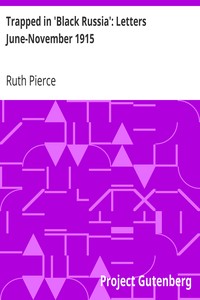
Trapped in 'Black Russia': Letters June-November 1915 by Ruth Pierce
In the summer of 1915, Ruth Pierce, a spirited young teacher from Ohio, sailed to Russia for a visit. She planned to see the sights, maybe do a little work, and return home before winter. It should have been a grand adventure. Instead, World War I turned her holiday into a trap. As fighting raged across Europe, Russia sealed its borders. Ruth's escape routes vanished one by one. What was supposed to be a few months stretched into a seemingly endless captivity, with her letters home as her only lifeline.
The Story
This book is those letters. We follow Ruth from June to November 1915, as her initial tourist's curiosity curdles into anxiety and then genuine fear. She writes about the small things first—the strange food, the difficulty of the language. But the world keeps closing in. She details food shortages, the chilling sight of wounded soldiers flooding the cities, and the rising tension in the streets. You see the glittering facade of imperial Russia splintering through her eyes. It's a ground-level view of history collapsing, reported by someone who just wants to catch the next boat home.
Why You Should Read It
What makes this book so special is Ruth's voice. She's not a politician or a general; she's a regular person in way over her head. Her letters are candid, sometimes funny, and often deeply frustrated. You feel her powerlessness, but also her sharp observations. She captures the eerie feeling of daily life continuing—people going to cafes, talking about the weather—while the foundations of society are crumbling. It makes history feel immediate and personal, not like a list of dates and battles. You're not just learning what happened, you're feeling what it was like to be there, wondering if you'll ever get out.
Final Verdict
Perfect for anyone who loves real-life stories that are stranger than fiction. If you enjoy first-person accounts of history, like personal diaries from big events, you'll be hooked. It's also great for readers who want to understand the human side of war—the civilians caught in the gears. You don't need to be a Russian history expert; Ruth was just as confused as any of us would be. This book is a compelling, intimate, and surprisingly relatable window into a world on the brink of revolution, seen through the eyes of a woman who desperately wanted a train ticket out.
This publication is available for unrestricted use. You do not need permission to reproduce this work.
Joseph White
4 months agoWhile browsing through various academic sources, the data points used to support the main thesis are quite robust. I feel much more confident in my knowledge after finishing this.
Joseph Taylor
8 months agoA brilliant read that I finished in one sitting.
Emily Jackson
10 months agoThe digital formatting makes it very easy to navigate.
Donald Moore
6 months agoInitially, I was looking for a specific answer, but the step-by-step breakdown of the methodology is extremely helpful for students. This should be on the reading list of every serious professional.


Susan Gonzalez
1 year agoA sophisticated analysis that fills a gap in the literature.