
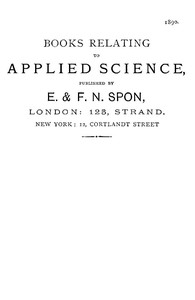
Books Relating to Applied Science, Published by E. & F. N. Spon, 1890.
Let's be clear from the start: this is not a novel. 'Books Relating to Applied Science' is a publisher's catalog. Published in 1890 by E. & F. N. Spon, it's a list of technical manuals, engineering guides, and scientific textbooks available for purchase. There's no plot in the traditional sense. Instead, the 'story' is told through the titles themselves and the brief descriptions provided.
The Story
The catalog organizes knowledge into chapters like Civil Engineering, Mechanics, Electricity, and Chemistry. You'll find entries for books on building railways, designing gas engines, practicing sanitary plumbing, and understanding the new theories of electricity. Each entry is a tiny snapshot of a world in furious transition. One page might offer a guide to using the recently invented telephone, while another details traditional methods of masonry. It's a record of the old ways bumping right up against the new. Reading it is like overhearing a conversation between the past and the future, with the publisher acting as the eager middleman.
Why You Should Read It
I found this fascinating because it strips away the hindsight we have today. We know how the 20th century turned out, but the people reading this catalog in 1890 didn't. To them, these books represented the cutting-edge tools to shape tomorrow. You see their priorities—public health, construction, industrial efficiency—laid bare. There's a palpable sense of optimism and problem-solving. It's also quietly funny in places, with overly earnest descriptions of now-obsolete technologies. It makes you appreciate the sheer volume of learning and tinkering that built our world.
Final Verdict
This is a niche read, but a rewarding one. It's perfect for history buffs, especially those interested in the Industrial Revolution or the history of technology. It's also great for engineers or scientists who enjoy seeing the roots of their fields. Don't go in expecting a narrative. Go in as an explorer, and let this catalog be your map to the mindset of 1890. You'll come away with a new appreciation for the ordinary books that helped build the extraordinary modern world.
This digital edition is based on a public domain text. Share knowledge freely with the world.
Karen Moore
1 year agoNot bad at all.
Margaret Walker
1 year agoSurprisingly enough, the pacing is just right, keeping you engaged. Highly recommended.
Lucas Lopez
1 year agoAmazing book.
Mason Nguyen
1 year agoEnjoyed every page.





Ashley Garcia
4 months agoIt’s refreshing to see such a high standard of digital publishing.