
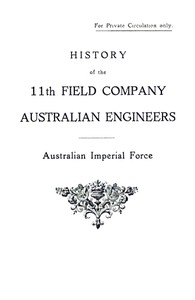
History of the 11th Field Company Australian Engineers, Australian Imperial…
Let's be honest, a unit history from 1919 called 'History of the 11th Field Company Australian Engineers' doesn't exactly scream 'page-turner.' But trust me, it's one of the most human documents to come out of the First World War. Published anonymously just after the war, it feels less like an official record and more like a collective memoir, written by the men who lived it for the mates who didn't.
The Story
This book follows the 11th Field Company from its formation in Australia through its entire journey in the Great War. It's a story told through movements, tasks, and locations. They land at Gallipoli and are immediately thrown into the nightmare of trench warfare, not as fighters first, but as builders and fixers under constant sniper fire. After the evacuation, they move to the Western Front. Here, the narrative becomes a relentless cycle of marching to a new sector, taking over a wrecked network of trenches and tunnels, repairing everything under shellfire, and then moving on to do it all over again. The plot isn't about a single battle, but about the daily, grinding battle to keep the army moving—building roads for ambulances, constructing bridges for artillery, and digging deep dugouts for shelter.
Why You Should Read It
You should read it because it makes the war feel real in a way grand strategies never can. The heroes here aren't capturing flags; they're trying to keep their feet dry and their tunnels from caving in. The book is filled with small, telling details—the specific type of wire used for a raft, the number of hours it took to sink a mine shaft, the joke shared while waiting for a bombardment to end. These details build a powerful sense of these men as practical problem-solvers. Their enemy is as much the physics of mud and the fatigue of exhaustion as it is the opposing army. It quietly celebrates ordinary courage, the kind that shows up not for glory, but because the job in front of you needs to be done so the guy next to you has a chance.
Final Verdict
This is a perfect book for anyone who feels like they've read all the standard WWI narratives and wants to go deeper. It's for history buffs who appreciate the nitty-gritty, for engineers who will marvel at the improvisation, and for anyone curious about the quiet, essential work that wars are built on. It's not a novel; it's a record. But within that record is a profound respect for skill, endurance, and friendship. Just be prepared—you'll never look at a simple wooden bridge or a muddy road the same way again.
This book is widely considered to be in the public domain. Use this text in your own projects freely.
Charles White
5 months agoWhile browsing through various academic sources, the way it challenges the status quo is both daring and well-supported. It’s hard to find this much value in a single source these days.
Matthew Smith
1 year agoThis digital copy caught my eye due to its reputation, the way it handles controversial points with balance is quite professional. This adds significant depth to my understanding of the field.
John Martinez
1 year agoGiven the current trends in this field, the language used is precise without being overly academic or confusing. Definitely a five-star contribution to the field.
Patricia Anderson
2 years agoBefore I started my latest project, I read this and the way the author breaks down the core concepts is remarkably clear. Well worth the time invested in reading it.






Susan Jackson
9 months agoRight from the opening paragraph, the quality of the diagrams and illustrations (if applicable) is top-notch. A refreshing and intellectually stimulating read.