
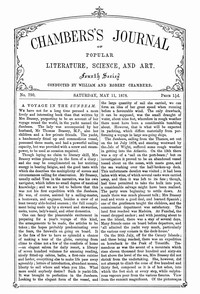
Chambers's Journal of Popular Literature, Science, and Art, No. 750, May 11,…
Forget everything you know about a modern book. Chambers's Journal No. 750 is a snapshot of a Saturday in May, 1878. It’s a weekly magazine, packed with short pieces meant to entertain and educate a middle-class Victorian family. There’s no single plot. Instead, you jump from topic to topic, just like the original readers did over their breakfast.
The Story
There isn't one story, but many. The issue opens with a fictional ghost story, full of eerie atmosphere and a mysterious old mansion. Then, it quickly shifts gears to a factual article about the oyster industry, explaining the careful process of cultivation in minute detail. You’ll find a thoughtful essay on the nature of dreams and memory, a practical guide on household management, and even a witty piece of social commentary. It’s all mixed together with poetry and brief notes on science and art. The ‘narrative’ is the experience of seeing the world through the eyes of 1878.
Why You Should Read It
I loved this because it’s so honest. This wasn’t written for historians; it was written for regular people. You see their fears in the ghost story, their ambitions in the science articles, and their daily concerns in the practical advice. The writing is clear and direct—these authors wanted to be understood. Reading it feels intimate, like you’ve found someone’s great-grandparent’s favorite magazine in the attic. It shows how people have always been a mix of superstitious and scientific, practical and romantic. The juxtaposition is often funny (oysters right after ghosts!), but it’s also deeply human.
Final Verdict
This is perfect for anyone with historical curiosity who finds textbooks dry. It’s for the reader who enjoys podcasts like ‘99% Invisible’ or ‘The History Hour,’ where the past is told through everyday objects and ideas. You won’t get a novel’s plot, but you’ll get something richer: a direct connection to the rhythm of thought in another time. Dive in for 15 minutes and you’ll be transported.
The copyright for this book has expired, making it public property. You are welcome to share this with anyone.
Paul White
1 year agoLooking at the bibliography alone, the level of detail in the second half of the book is truly impressive. A mandatory read for anyone in this industry.
Ashley Lopez
2 years agoOne of the most comprehensive guides I've read this year.
Sarah Davis
10 months agoThis is an essential addition to any academic digital library.
Robert Lee
1 year agoThe clarity of the introduction set high expectations, and the author doesn't just scratch the surface but goes into meaningful detail. Well worth the time invested in reading it.






John Thomas
9 months agoIf you're tired of surface-level information, the quality of the diagrams and illustrations (if applicable) is top-notch. This exceeded my expectations in almost every way.