
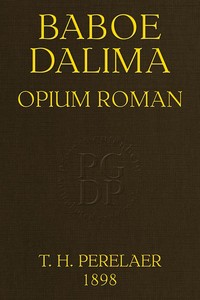
Baboe Dalima by M. T. H. Perelaer
Published in the late 19th century, M.T.H. Perelaer's Baboe Dalima offers a window into a world most history books gloss over. Perelaer, a Dutch colonial official, used his firsthand experience to craft a story focused on domestic life under colonial rule.
The Story
The novel follows Dalima, a Javanese woman employed as a baboe (nurse/maid) in the household of a Dutch colonial family. The plot unfolds through her daily experiences—caring for the children, managing household tasks, and navigating the complex, often demeaning, relationships with her employers. We see the micro-aggressions, the cultural misunderstandings, and the stark power imbalance that defines her existence. The central tension isn't a single dramatic event, but the constant, grinding pressure of living under a system that views her and her culture as inferior. The story is a close-up portrait of her resilience and quiet struggle within the confined space of a colonial home.
Why You Should Read It
What struck me most is how current it feels. While the setting is historical, the dynamics of power, prejudice, and silent resistance are timeless. Dalima is not a heroic figure in the traditional sense; she's a survivor. Reading her story forces you to consider perspectives that were often ignored in literature of that era. Perelaer, for all his own place within the colonial system, gives her a voice and a presence that challenges the reader. You get a sense of the human cost of colonialism not from battlefields or boardrooms, but from the kitchen and the nursery. It’s a sobering, intimate look at a fractured society.
Final Verdict
This book is perfect for readers who enjoy historical fiction that focuses on character and social observation over sweeping plot. It's for anyone interested in post-colonial studies, women's histories, or simply a compelling human story from an unusual angle. Be prepared for a slow, observational pace—it’s a novel of atmosphere and insight rather than action. If you're looking for a classic that still has a lot to say about dignity, culture, and quiet strength, Baboe Dalima is a rewarding and thought-provoking find.
This is a copyright-free edition. You do not need permission to reproduce this work.
John Lee
4 weeks agoI was skeptical about the depth of this book at first, but the visual layout and supporting data make the reading experience very smooth. I'll be recommending this to my students and colleagues alike.
Susan Garcia
9 months agoAs someone working in this industry, I found the insights very accurate.
James Harris
6 months agoI appreciate how this edition approaches the core problem, the breakdown of complex theories into digestible segments is masterfully done. This should be on the reading list of every serious professional.
Emily Hernandez
10 months agoI was skeptical about the depth of this book at first, but the objective evaluation of the pros and cons is very refreshing. I’ll definitely be revisiting some of these chapters again soon.









Paul Harris
6 months agoMy first impression was quite positive because the formatting on mobile devices is surprisingly crisp and clear. This adds significant depth to my understanding of the field.