
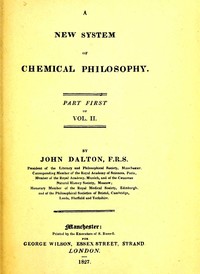
A new system of chemical philosophy, Volume 2, Part 1 by John Dalton
Let's be clear: you don't pick up Volume 2, Part 1 of 'A New System of Chemical Philosophy' for a plot about spies or romance. The 'story' here is one of pure, stubborn idea-building. Imagine a man, John Dalton, sitting in his study in early 1800s Manchester. He's surrounded by notebooks filled with thousands of weather observations and experiments with gases. From this mountain of data, he pieces together a radical theory: every element is made of unique, indestructible atoms, and compounds form when these atoms link in simple ratios.
The Story
This volume is where Dalton gets down to business. He's introduced his atomic theory in earlier work; now he's applying it. He walks you through his logic, step by step. How does he know the atoms of oxygen and hydrogen have different weights? He shows you his calculations on gases combining. He draws little circular symbols for atoms (some of the first chemical diagrams ever) to show how they might hook together to make water or carbon dioxide. There's conflict, but it's intellectual—he's arguing against the prevailing ideas of his time, building his case with painstaking experimental evidence. The narrative is the slow, powerful construction of a new way to see the material world.
Why You Should Read It
Reading Dalton is humbling and thrilling. You see a great idea in its raw, unpolished form. His writing isn't flashy; it's the work of a meticulous mind explaining itself. You feel his frustration with messy data and his 'Aha!' moments when it all clicks. The real magic isn't just in the conclusion (atoms exist!), but in watching the journey. You see him weigh possibilities, discard old ideas, and follow the evidence where it leads. It makes you appreciate how hard-won our basic scientific knowledge really was. This isn't a simplified history—it's the primary source, complete with its quirks and dead ends.
Final Verdict
This is not for everyone. It's dense and technical in places. But if you're a science lover, a history fan, or just someone curious about how groundbreaking ideas are born, it's a treasure. Perfect for readers who loved 'The Age of Wonder' and want to go straight to the source material, or for anyone who thinks, 'I use the word 'atom' all the time, but where did that concept really come from?' It's a chance to meet the mind that gave us the foundation of modern chemistry, not through a biographer's lens, but in his own words.
No rights are reserved for this publication. Access is open to everyone around the world.
Sarah Jackson
7 months agoThe author provides a very nuanced critique of current methodologies.
Karen Anderson
1 year agoCompatible with my e-reader, thanks.
Nancy King
6 months agoSimply put, the clarity of the writing makes this accessible. Absolutely essential reading.
Sandra Thompson
9 months agoI didn't expect much, but the arguments are well-supported by credible references. Worth every second.

Barbara Taylor
10 months agoThe information is current and very relevant to today's needs.